


📝 Blog Summary
OpenSIPS 4.0 marks a massive architectural shift, completely abandoning the legacy multi-process TCP model in favor of an optimized, multi-threaded I/O engine.
This comprehensive guide decodes the core elements driving this release: from structural multi-threaded TCP/TLS overhauls and dynamic branch allocations to the introduction of DNS-driven bond sockets and cluster-bridge WAN replication.
Whether you are aiming to eliminate OpenSSL process crashes or map out an enterprise upgrade path, here you’ll find the deep technical insights and migration steps required to manage high-throughput SIP routing in 2026.
If you are running a large-scale UCaaS, CPaaS, or wholesale carrier network, your primary infrastructure bottleneck isn’t UDP routing. It’s the crushing overhead of maintaining hundreds of thousands of concurrent TCP and TLS connections.
Modern SIP traffic (driven heavily by mobile endpoints, Microsoft Teams Direct Routing, and strict load balancers) has fundamentally changed the transport layer rules.
For more than two decades, the core network architecture of open-source SIP proxies remained virtually unchanged. But the release of OpenSIPS 4.0 brings a profound shift to the ecosystem. It is not a basic, incremental feature drop; it is a ground-up engineering rewrite designed to eliminate legacy structural limits that have plagued operators for years.
If you are struggling to minimize call setup delays, attempting to eliminate unexplainable process crashes, or evaluating a production migration from the 3.x series, overviews won’t be enough.
You need a transparent look at the underlying architectural changes, performance benchmarks, and configuration realities. Let’s break down exactly what OpenSIPS 4.0 brings to live systems.
Why Did OpenSIPS 4.0 Completely Overhaul Its Core Architecture?
OpenSIPS 4.0 overhauled its core architecture to remove decades-old engineering bottlenecks. They were mostly in multi-process TCP handling, static branch memory allocation, and rigid outbound socket selection that restricted carrier-grade system scaling.
The older architecture worked beautifully in an era dominated by simple UDP traffic. However, as the industry transitioned toward highly secure, TLS-encrypted trunking and permanent TCP channels for mobile push notifications, the legacy design began showing its age.
OpenSIPS 4.0 serves as a pivotal turning point. Instead of patching old components, the development team rebuilt the platform’s core mechanics to handle modern, high-concurrency workloads without sacrificing raw execution speed.
Multi-Threaded TCP/TLS Process Engine Vs. Legacy Workers
The performance difference is that the new multi-threaded TCP/TLS engine eliminates internal inter-process communication (IPC) bottleneck overhead entirely. It does this by managing all concurrent connections inside a single process memory block using dedicated native I/O threads.
In the classic 3.x multi-process model, a single master “TCP Main” process accepted incoming TCP connections and physically passed the file descriptors over Unix domain sockets to separate worker processes. At a massive scale (say, 50,000 active TLS sessions), this internal message-passing mechanism created a severe architectural bottleneck, driving up system latency and CPU context switching.
OpenSIPS 4.0 replaces this entire multi-process structure with a streamlined, centralized, multi-threaded I/O model running inside a single dedicated process.
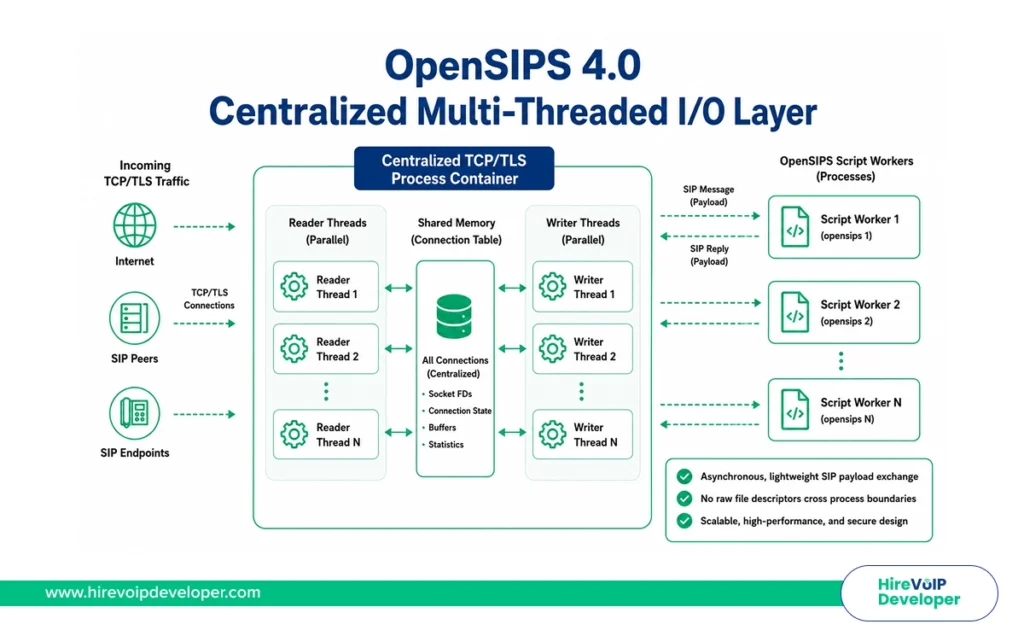
How the OpenSIPS 4.0 Multi-Threaded I/O Architecture Functions
Under the new design, a single, specialized process manages all active TCP and TLS connections. Within this process, multiple dedicated reader and writer threads handle raw network I/O operations directly.
When a packet arrives, the reader threads capture the raw message and pass it directly to the primary OpenSIPS worker processes for SIP-level script handling. When a worker needs to send a message back out, it passes the data to this central TCP process using a low-overhead asynchronous write architecture. This entirely eliminates the need to pass connection descriptors across process boundaries.
Eradicated OpenSSL Cryptographic “Twitch”
Because the old architecture split connection states across multiple distinct processes, using traditional crypto libraries like OpenSSL required complex internal hacks and “twitches” to synchronize shared state safely. This frequently resulted in memory conflicts, race conditions, or unexplained process crashes under heavy traffic spikes.
Because OpenSIPS 4.0 consolidates connection management into a single multi-threaded process, it can use the OpenSSL library exactly as it was natively designed to be used. The complex state-synchronization workarounds have been entirely removed.
Furthermore, WolfSSL is now established as the default out-of-the-box cryptographic library for core security modules like STIR/SHAKEN. It is dynamically linked rather than statically imported, allowing operators to patch or update system dependencies via standard OS package managers (without forcing a complete recompile of OpenSIPS).
OpenSIPS 3.x Process Model Vs. OpenSIPS 4.0 Multi-Threaded Engine
Struggling with high CPU usage or frequent OpenSSL crashes on your current SIP proxy?
Relying on out-of-the-box system configurations or outdated multi-process architectures under high TLS volumes is an operational risk.
Our core infrastructure teams can help analyze your platform and implement a stable, high-throughput routing engine.
What Are Bond Sockets In OpenSIPS 4.0 And When to Use Them?
Bond sockets are a collection of physical network interfaces grouped together as a single virtual socket. They’re used to dynamically handle outbound protocol and interface matching based on destination properties discovered via last-millisecond DNS resolutions.
In every release prior to 4.0, OpenSIPS required you to statically define the exact interface and protocol combination you wanted to use for outbound routing directly within the script. While this works fine for fixed IP-to-IP peering, it fails completely in modern, dynamic interconnect environments.
If your script targets a remote carrier using a Fully Qualified Domain Name (FQDN), you have no way of knowing before execution whether that DNS lookup will return an IPv4 or IPv6 address, or if it will resolve to a preference for UDP, TCP, or TLS. Historically, trying to manually force socket matching for these edge cases required adding complex, messy conditional branches to your routing script (heavily degrading performance).
The OpenSIPS 4.0 bond socket completely abstracts this layer. It acts as a logical umbrella for a group of varied real sockets. When an outbound request is sent to an FQDN target, the core engine performs DNS resolution in the last millisecond. It evaluates the required address family and protocol, and automatically selects the optimal underlying socket from the bond. This ensures flawless multi-protocol failover and completely eliminates script clutter.
💡 Expert Tip
Historically, many engineers turned on the global mhomed (multi-homed) parameter to automatically route traffic across asymmetric networks. However, mhomed relies strictly on the OS routing table, which is completely blind to SIP-level protocol variants (like a destination suddenly requiring TLS instead of UDP).
In OpenSIPS 4.0, group your public, private, IPv4, and IPv6 interfaces into an explicit bond socket definition to give the application layer direct control over your transport-level selection.
Advanced OpenSIPS 4.0 Scaling Features
Beyond the massive network I/O overhaul, OpenSIPS 4.0 updates several critical sub-systems to support high-density carrier operations.
1. Dynamic Transaction (TM) Branches
In previous iterations, the maximum number of branches a transaction could fork to (such as serial or parallel hunting destinations) was hard-coded at compile time (typically limited to 32 or 64 branches). Worse, memory for the maximum number of branches was statically allocated for every single transaction from day zero, resulting in significant chunk memory waste.
In complex Class V environments with cascading hunt groups, simultaneous push notifications, and multi-device parallel ringing, 64 branches often weren’t enough. OpenSIPS 4.0 moves to a dynamic memory allocation model for branches. Transactions now consume minimal memory by default and dynamically scale up to support 256+ branches on demand without memory inflation.
2. Native Proxy Protocol Support
Modern infrastructure heavily leverages cloud-edge load balancers (like HAProxy, AWS ALB, or Cloudflare) to distribute traffic. However, these intermediate network layers strip away the original sender’s IP address, blinding the upstream SIP proxy.
OpenSIPS 4.0 introduces native support for the Proxy Protocol. By parsing the metadata wrapper directly at the transport socket level, the core exposes the client’s original source IP, port, and protocol via the new $proxy_protocol script variable, enabling seamless NAT traversal and fraud detection behind massive external load balancers.
3. Real-Time X-Ray Process Profiling
When a production proxy experiences sudden latency spikes, figuring out exactly why a process is running slowly can be highly difficult.
OpenSIPS 4.0 addresses this by adding an internal, per-process microsecond profiling engine. Using the new profiling_proc Management Interface (MI) command, you can run a real-time diagnostic scan on an active worker process to isolate routing script, database loop, or timer bottlenecks instantly.
4. Cluster-Bridge Replication for WAN Optimization
Operating geo-distributed data centers usually means dealing with expensive, low-bandwidth WAN links. Prior to 4.0, syncing active clustering data across nodes meant blasting state updates globally, choking cross-border connections.
OpenSIPS 4.0 solves this by introducing Cluster-Bridge Replication. Nodes are organized into localized “islands” connected by designated communication bridges, dropping WAN overhead significantly while maintaining tight replication modules for high-scale applications like distributed rate-limiting.
The OpenSIPS 3.x To 4.0 Migration Guide
The core changes required when migrating from OpenSIPS 3.x to 4.0 include upgrading your DB schema structures, rewriting legacy single-letter dialog module flags into full string parameters, and re-tuning global process scaling values.
If your team is mapping out an upgrade timeline, your deployment checklist must account for these critical structural changes:
1. Rebuild Your Database Schema
The underlying data structures for modules like dialog, usrloc, and clusterer have been modified to support 4.0’s multi-threaded state management. Use the opensips-cli migration tool to generate your new production database definitions:
opensips-cli -x database migrate 3.6_to_4.0 opensips_3_6_db opensips_4_0_db
2. Audit and Rewrite the create_dialog() Flags
This is a silent breaking change that will immediately prevent legacy scripts from compiling. OpenSIPS 4.0 completely discards the classic single-letter configuration flags inside the dialog module. You must rewrite them using their new full, hyphenated, explicit string parameters.
- Old 3.x Syntax: create_dialog(“B”); (or similar single-letter switches)
- New 4.0 Syntax: Must be updated to use complete hyphenated parameter names matching your explicit routing requirements.
3. Rethink Your Process Scaling Parameters
Because the TCP worker pools have been completely consolidated into the single multi-threaded process block, your global opensips.cfg configuration needs to be re-tuned. Review your children definitions and ensure your thread-count parameters match the multi-core layout of your target infrastructure.
The era of relying on antiquated multi-process voice infrastructure is over. OpenSIPS 4.0 provides the precise performance foundation required to process modern, high-density secure traffic profiles without hitting a processing ceiling. However, transitioning a live, high-volume routing core requires highly calculated execution.
You can either stay constrained by legacy multi-process architecture bottlenecks. Or, you can take control of your threading pools, minimize your shared memory footprints, and deploy an open-source proxy environment engineered to handle true carrier-scale throughput.
Ready to safely migrate to OpenSIPS 4.0 and optimize your high-volume signaling architecture? Consult our core open-source telecom specialists today!