
Building a Multi-Role Telemedicine Platform for Online Consultations
How we built a multi-role telemedicine platform where patients reach verified doctors over live video and chat, on the web and on their phones.


The Challenge
A healthcare technology provider came to us wanting to move consultations online. The concept was simple to state. A patient should be able to open a browser or their phone, book a doctor, and talk to them over video or chat without any friction. Building it was harder, because the platform had to serve several different kinds of users at once and handle money, medical records, and live communication without dropping any of them. Three problems shaped the work.
Live video and chat that works on web and mobile alike
A consultation is worthless if the video freezes or the call drops halfway through. The platform needed live video and text chat that behaved the same whether a patient was on a desktop browser or a mid-range Android phone on a weak connection. That meant treating the communication layer as the hardest part of the build, not a feature to add near the end.
Five kinds of users, one platform
Patients, doctors, labs, support agents, and administrators all needed to work inside the same system, and none of them should see another group's tools or data. A patient books and consults. A doctor consults and prescribes. A lab takes orders and uploads reports. An agent coordinates bookings. An administrator watches over the whole thing. Designing clean separation between those roles, without building the application five times over, was most of the architectural work.
Money and medical history, handled carefully
Appointments involve payment, and healthcare involves records that have to stay accurate and private. The platform had to take payments, issue refunds, move funds to doctors, and keep every consultation and lab result attached to the correct patient history. All of that has to meet the privacy expectations that come with medical data, so it could not be bolted on at the end.
The Solution
We built the platform as a role-based system with a shared communication and payment core, so each type of user gets a focused interface while the heavy lifting happens once underneath.
Real-time consultations on web and mobile
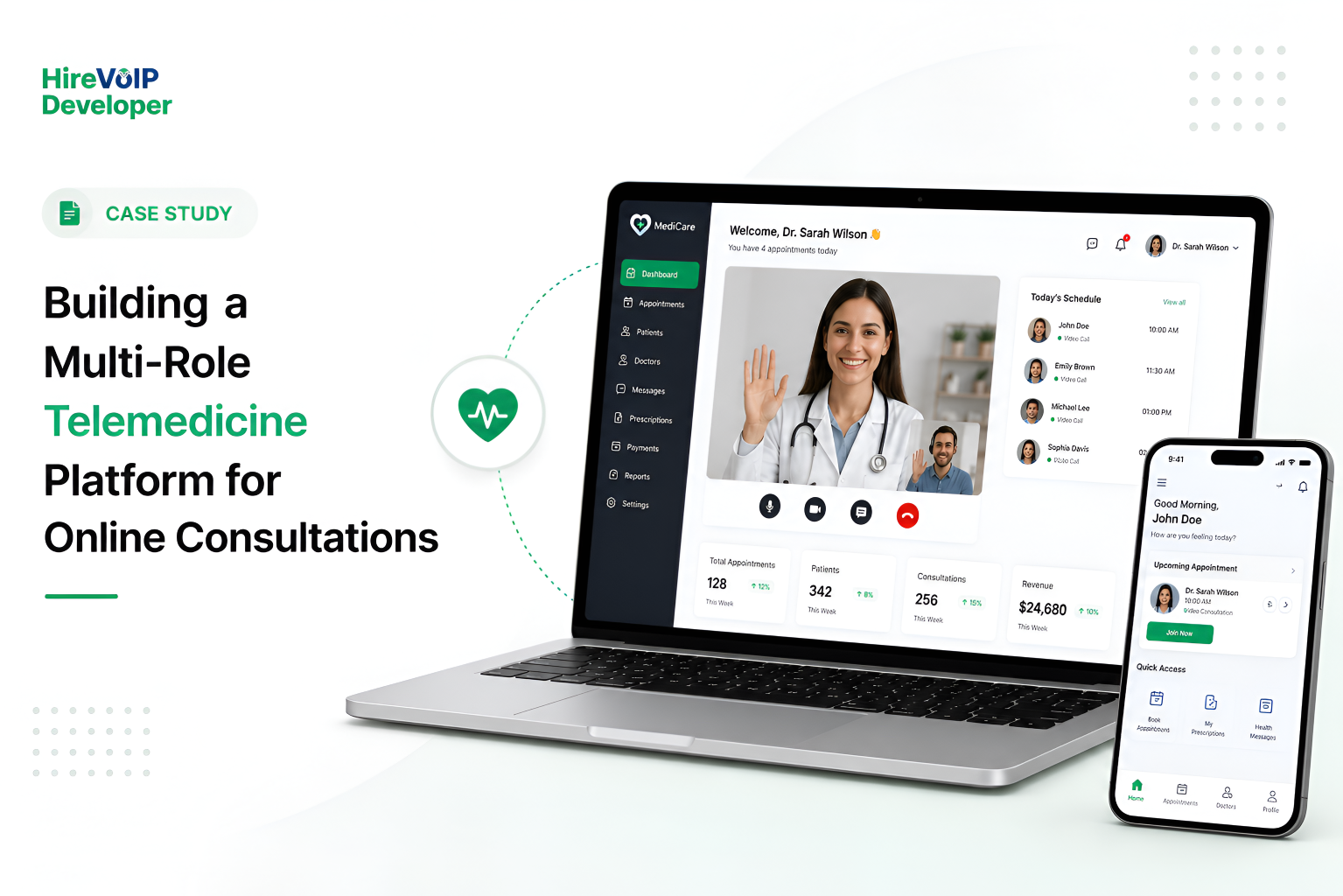
Patients connect with doctors over live video or text chat, for both first visits and follow-ups. The video and chat run on WebRTC, which keeps latency low and avoids routing media through a heavy server path. The same consultation works across the responsive web portal and the native mobile apps, so a patient can book on a laptop and take the call on their phone without relearning anything. Our WebRTC developers handled the media negotiation and the reconnection logic that decides whether a shaky call recovers or drops.
One platform, five roles
Each user type gets its own workspace. Patients onboard, book appointments, consult, browse health tips, and manage payments. Doctors set their availability, run consultations, write prescriptions, and raise lab orders. Labs receive those orders, track availability, and upload reports. Support agents manage bookings and help patients who get stuck. Sitting above all of them, a super admin portal oversees every user, role, lab, and payment, while a separate admin layer manages packages, health tips, and transaction reporting. Permissions keep each role inside its own lane.
Scheduling, payments, and a shared wallet
Booking, payment, and payouts run through one connected flow. Patients pay when they book. Refunds and transfers happen inside the system rather than through a manual side process. Doctor payouts and platform commissions are configurable, so the business side can change how money moves without a code change. Labs are paid for their work through the same wallet, and receipts sync back automatically, so finance sees one consistent picture instead of three.
Verified doctors and connected records
Doctor accounts are checked before they go live, so patients are matched with practitioners who have been verified rather than anyone who filled in a signup form. Every consultation, prescription, and lab result attaches to the patient's history, so a doctor picking up a follow-up already sees what came before. SMS notifications keep patients current on appointments and updates, and health tips written by professionals are bundled into select packages for patients who want to stay engaged between visits.

5 Roles
Patients, doctors, labs, agents, and admins on one platform

Web + Mobile
Live consultations from a browser or a phone

WebRTC
Real-time video and chat, low latency
Ready to scale your VoIP infrastructure?
Let our experts architect a high-performance, resilient communication platform tailored to your specific requirements.
Get Started Today