


📝 Quick Summary
Learn how media paths, jitter, packet loss, and hidden infrastructure constraints impact RTP quality in large FreeSWITCH systems, and the troubleshooting strategies that actually resolve them.
Everything sounds fine until traffic scales.
Calls are clear in staging, load tests pass, and early deployments run smoothly. Then concurrency rises, and suddenly users report robotic audio, clipped speech, or noticeable delay.
This is where many teams realize an uncomfortable truth:
“It works” is very different from “it works at 10,000 concurrent calls.”
Staging environments rarely replicate production chaos, unpredictable carrier routes, microbursts, virtualization noise, and competing network traffic. What looks stable at low volume can quickly unravel under real-world conditions.
And unlike other workloads, voice has no tolerance for recovery.
RTP doesn’t support retransmission; once packets are lost, they are lost.
❌ No retransmissions.
❌ No second chances.
Just degraded conversations.To prevent that outcome, many teams choose to hire FreeSWITCH developers who understand how media truly flows through the system, because at scale, most audio issues stem from the path, not the platform.
💭 Myth
Voice quality issues appear suddenly.
✅ Fact
They usually build gradually through small timing inconsistencies, until concurrency exposes them.
Understanding the Media Path in FreeSWITCH
Before diving into jitter or packet loss, map the media path. Because in large deployments, audio degradation is rarely caused by a single component, it’s usually the accumulated effect of multiple hops.
1. RTP Handling in FreeSWITCH
FreeSWITCH is optimized for real-time media, but how it processes RTP depends heavily on your media strategy. The platform can stay in the path, step out of it, or actively manipulate streams, and each approach has performance implications.
2. Media Modes: Proxy vs Bypass vs Transcoding
Proxy mode keeps FreeSWITCH forwarding RTP packets. This improves visibility and control but introduces processing overhead that grows with concurrency.
Bypass mode allows endpoints to exchange media directly. Latency drops, CPU usage improves, and jitter often stabilizes, provided your endpoints and network are trustworthy.
Transcoding, however, is where systems begin to feel pressure. Every codec conversion consumes CPU and introduces buffering. Under load, those buffers can expand and manifest as FreeSwitch RTP delay, especially during peak CPS.
3. Sources of Latency in the Media Path
Latency is rarely dramatic at a single point, it builds gradually across the path:
- SBC inspection layers
- Carrier routing decisions
- NAT traversal
- Encryption overhead
- Cloud network hops
Individually, these may seem harmless. Collectively, they reshape conversation flow.
4. Impact of Media Touchpoints on Call Quality
Each device touching RTP introduces scheduling, queuing, or processing delay. At a small scale, this is tolerable. At a large scale, timing precision starts to erode.
FYI
RTP problems rarely begin as major failures, they build quietly through small timing inconsistencies until call quality noticeably drops.
Knowing how media travels is important; knowing what interferes with it is critical.
Why Does RTP Quality Degrade in Large FreeSWITCH Deployments?
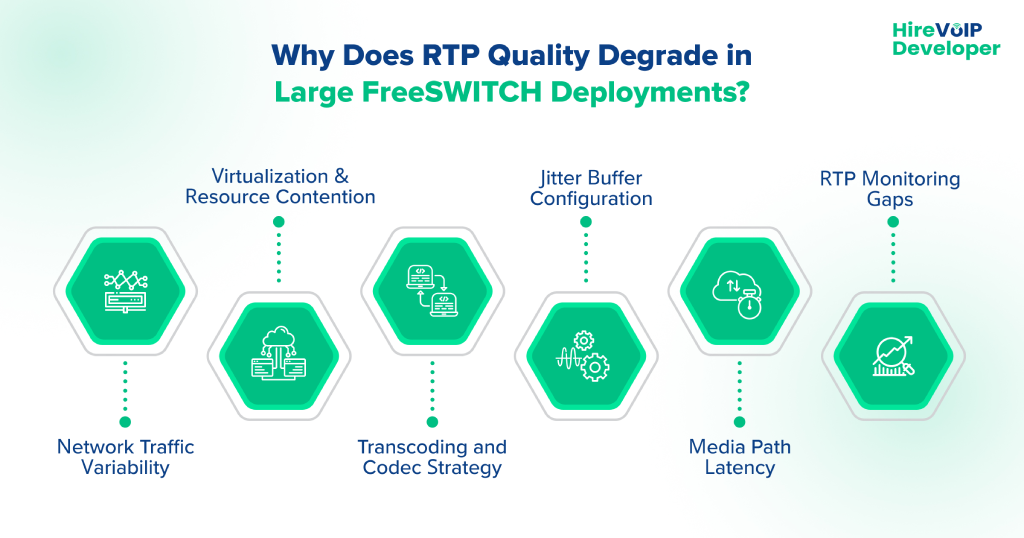
When RTP quality declines in large FreeSWITCH deployments, the instinct is often to blame bandwidth constraints. In reality, degradation typically results from timing inconsistencies across the infrastructure rather than a single overloaded component. Voice traffic depends on steady packet delivery, so even small disruptions in processing, routing, or buffering can quickly affect call clarity.
Addressing these issues requires looking beyond surface metrics and understanding how network behavior, compute resources, and media handling interact under scale.
1. Network Traffic Variability
Adequate bandwidth does not always translate to stable media delivery. RTP is highly sensitive to packet timing, and short-lived traffic spikes can disrupt sequencing even when overall utilization appears normal.
Microbursts are a common example, brief surges that overflow switch buffers within milliseconds. Because they are transient, they often evade traditional monitoring while still introducing jitter.
Oversubscribed network interfaces can produce similar effects. As queues build, packets arrive late rather than being lost, which manifests as jitter rather than obvious packet drops.
Internal east-west traffic also deserves attention. Large data transfers, replication processes, or container movement can compete with media streams and create unpredictable latency inside the data center.
The takeaway: consistent packet flow matters more than peak bandwidth.
2. Virtualization and Resource Contention
Virtualized and cloud environments add abstraction layers that influence packet scheduling. While these platforms offer scalability, they can introduce variability that real-time media struggles to tolerate.
The noisy neighbor effect occurs when shared workloads consume disproportionate resources, delaying packet processing. Similarly, CPU steal time indicates that a virtual machine is ready to execute but waiting for physical CPU access, a condition that can directly translate into jitter.
Hypervisor scheduling delays further contribute to irregular packet handling. Individually minor, these delays can compound under high concurrency.
For media-heavy workloads, predictability is often more valuable than elastic compute capacity.
3.Transcoding and Codec Strategy
Transcoding is one of the most resource-intensive operations in the media path. Each conversion requires real-time decoding and encoding, increasing CPU load and buffer utilization. As traffic grows, these buffers may expand, leading to noticeable FreeSwitch RTP delay during conversations.
Codec mismatches frequently force unnecessary transcoding. Standardizing codec preferences across endpoints and carriers can significantly reduce processing overhead.
Conferencing environments require additional caution. Media mixing requires tight synchronization, and resource pressure can introduce artifacts, challenges historically associated with scenarios such as the FreeSwitch conference jitter bug.
4. Jitter Buffer Configuration
A well-tuned FreeSWITCH jitter buffer RTP setup smooths packet variation, but a poorly configured setup can introduce new issues.
- Larger buffers reduce distortion but add latency.
- Smaller buffers reduce latency but introduce jitter.
The goal is to tune the FreeSwitch jitter buffer based on real network behavior and adjust gradually as traffic patterns evolve.
5. Media Path Latency
Latency typically accumulates across multiple layers rather than originating from one source. Common contributors include using FreeSWITCH as SBC, encryption, NAT traversal, firewall queues, and geographic routing.
Each additional media touchpoint increases the chance of timing disruption, making simplified media paths a critical design priority.
6. RTP Monitoring Gaps
RTP issues often develop before averages reflect them. Calls may degrade while dashboards still appear healthy.
Correlating jitter, packet loss, and MOS, instead of relying solely on signaling metrics, provides earlier visibility into user experience.
Once the root causes are clear, the focus shifts to troubleshooting them effectively.
How to Troubleshoot RTP Issues in High-Concurrency FreeSWITCH Environments?
Troubleshooting RTP in large FreeSWITCH systems is less about reacting to complaints and more about following a structured diagnostic approach. Because media issues can originate anywhere along the call path, effective troubleshooting focuses on isolating variables rather than making broad configuration changes.
The goal is simple: identify where packet timing breaks, and why.
Media Path Analysis
SIP confirms that a call connected; RTP determines whether the conversation was usable. Relying solely on signaling logs can create a false sense of stability.
Instead, prioritize RTP statistics and correlate them with user experience metrics such as MOS, jitter, and packet loss. When these indicators are reviewed together, patterns emerge much faster than when analyzed in isolation.
This is often the quickest way to confirm whether you are dealing with network variability, compute pressure, or media handling delays, such as FreeSWITCH RTP delay. As deployments grow, incorporating FreeSWITCH load balancing becomes critical to ensure calls are distributed evenly across media nodes rather than concentrating risk on a single server.
Path Segmentation
Attempting to troubleshoot the entire route at once slows resolution. A better approach is to test each segment independently:
- Endpoint → Edge
- Edge → FreeSWITCH
- FreeSWITCH → Carrier
This structured method narrows the fault domain quickly and prevents unnecessary configuration changes. If one segment shows clean delivery while another introduces jitter, the investigation becomes immediately more focused.
Think of it as a binary search for media quality.
Capture Packets Strategically
Packet captures remain one of the most reliable diagnostic tools, when used selectively.
Instead of running continuous captures, target periods when degradation is reported. Short, controlled captures are easier to analyze and typically reveal sequencing gaps, delayed packets, or burst loss.
Sampling is often sufficient for intermittent issues, while persistent problems may justify deeper inspection.
The objective is clarity, not excessive data collection.
Infrastructure Validation
It is tempting to adjust buffers or timers at the first sign of trouble, but platform tuning should come after infrastructure validation.
Check for:
- Interface saturation
- CPU spikes or steal time
- Network queueing
- Sudden traffic shifts
If the underlying environment is unstable, configuration changes, including adjustments to the FreeSwitch jitter buffer, will only mask symptoms temporarily.
Stability at the infrastructure layer should always come first.
Jitter Buffer Optimization
When packet timing variation is confirmed, tuning the FreeSwitch jitter buffer RTP configuration can improve audio consistency. However, changes should be incremental.
Increasing buffer size may smooth playback but can introduce conversational delay. Reducing it lowers latency but exposes distortion during traffic fluctuations.
Adaptive buffering often performs well in dynamic environments, provided it is monitored and adjusted based on observed behavior rather than assumptions.
Media Processing Reduction
Every processing step adds latency. If troubleshooting repeatedly points toward compute pressure, reassess whether media handling can be simplified.
- Avoid unnecessary transcoding through codec alignment.
- Keep media paths as direct as possible.
- Evaluate conferencing workloads carefully, as mixing environments are more sensitive to timing, an area historically highlighted by scenarios such as the FreeSwitch conference jitter bug.
Often, the most effective optimization is removing complexity rather than tuning around it.
RTP Performance Monitoring
RTP degradation rarely begins as a major outage; it typically surfaces as small, repeatable anomalies.
Monitoring should focus on trends instead of isolated thresholds. Gradual increases in jitter or packet loss usually signal emerging constraints before users begin reporting issues.
Teams that treat media telemetry as a primary signal, rather than a secondary metric, tend to resolve problems faster and prevent recurrence.
Best RTCP Monitoring Tools for Real-time Jitter Tracking in a CPaaS?
Troubleshooting helps resolve immediate RTP issues, but maintaining call quality requires continuous visibility. RTCP provides real-time insight into jitter, packet loss, and latency, allowing teams to detect degradation early instead of reacting to user complaints.
In CPaaS environments, where traffic patterns shift rapidly, this level of monitoring becomes essential for operational stability.
What to Look For in an RTCP Monitoring Tool
Prioritize platforms that offer:
- Real-time jitter and packet loss reporting
- MOS visibility for user experience tracking
- Alerting for faster incident response
- Historical analytics for capacity planning
- Per-call diagnostics for quicker root-cause analysis
Tools that unify signaling and media metrics are especially valuable because they reduce blind spots in troubleshooting.
Commonly Used RTCP Monitoring Tools
- Homer SIP Capture – widely used for deep packet and QoS analysis.
- VoIPmonitor – recognized for MOS tracking and jitter visualization.
- sngrep – lightweight and effective for real-time signaling inspection.
- SolarWinds VoIP & Network Quality Manager – suited for teams needing integrated network and voice monitoring.
Ultimately, the best tool is one that aligns with your observability strategy and scales with your traffic.
As infrastructure grows, RTCP telemetry also helps validate whether optimizations, such as codec alignment, FreeSWITCH jitter buffer tuning, or FreeSWITCH load balancing, are genuinely improving media performance.
Now that we’ve covered the causes and fixes, let’s step back and focus on what keeps RTP performance consistently reliable.
The Bottom Line?
The data indicates 876 tracked companies using FreeSWITCH, primarily in telecommunications (27%), IT services (23%), and software (15%). Usage is heaviest among mid-sized firms (10-50 employees, $1M-10M revenue), with 43% in the US and 7% in India; it holds about 1.6% market share in telephony technologies.
And so, maintaining RTP quality in large FreeSWITCH environments requires more than reactive troubleshooting. As systems scale, media stability becomes a function of network consistency, compute predictability, and disciplined configuration.
🗝️ Key Takeaways:
- Trace the media path to isolate issues before changing configurations.
- Prioritize infrastructure stability over aggressive tuning.
- Minimize unnecessary media processing to preserve packet timing.
If your platform is showing early signs of degradation, rising jitter, intermittent distortion, or persistent FreeSWITCH RTP delay, working with an experienced FreeSWITCH consulting company can significantly accelerate resolution. When you build with Hire VoIP Developer large-scale deployment expertise, you gain structured troubleshooting, optimized FreeSwitch jitter buffer strategies, and an architecture designed to sustain growth without compromising call quality.
In high-concurrency voice systems, reliable audio is not achieved through quick fixes; it is the result of deliberate design and continuous operational discipline.