
📝 Blog Summary
Building a voice AI agent that works over a web browser is easy. Making it feel natural over a live SIP trunk is where VoIP engineers run into walls.
While native Speech-to-Speech (S2S) models skip text processing to shave off response delay, hooking them up to real carrier trunks can bring up nasty surprises. This blog will walk you through the full-path latency from carrier ingress to RTP egress so you can pick the right engine for your platform.
If you test a native Speech-to-Speech (S2S) model in a clean web browser sandbox, it feels like magic. The AI matches your tone, catches your sarcasm, and responds almost instantly. Then you wire that exact same model to a live SIP trunk, send it through a Session Border Controller (SBC), squeeze the audio down to G.711 μ-law over a spotty mobile connection, and watch your fast demo degrade into multi-second lag.
Evaluating speech-to-speech vs. STT-LLM-TTS can be a big media plane problem. Every tiny delay in RTP packet buffers, audio transcoding, or network jitter queues eats into your conversational response window.
Let’s break down how these two architectures perform on real telephony lines, where the delays hide, and how to choose what to build for your VoIP platform.
What Is the Real Difference Between Speech-to-Speech and Cascaded Pipelines?
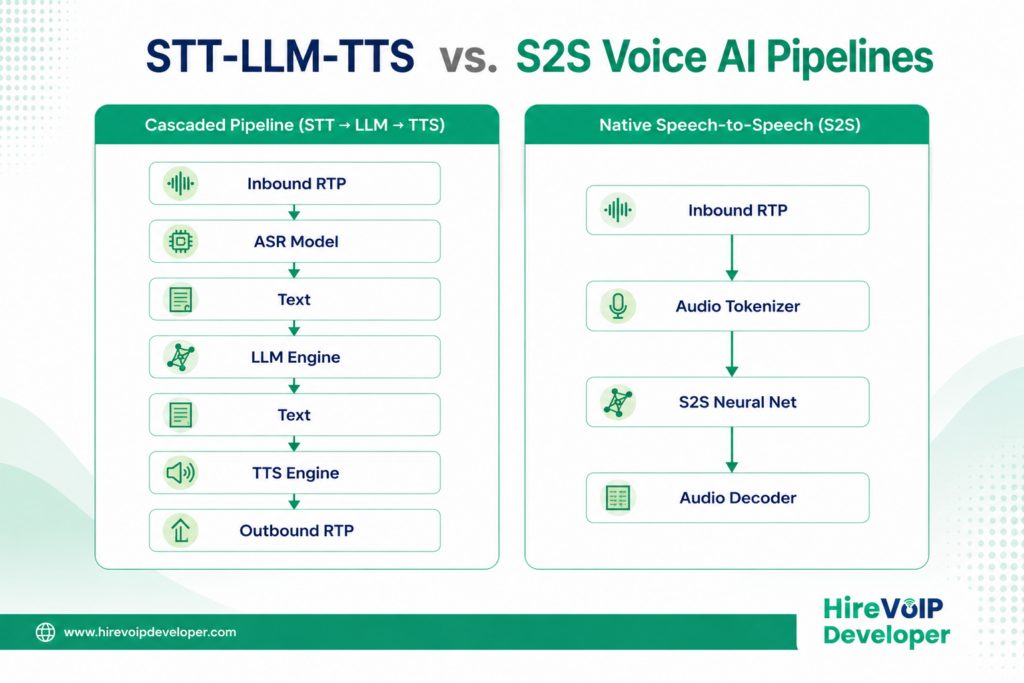
In a cascaded pipeline, three separate AI models pass data to each other like a relay race (Audio → Text → Text → Audio). In a native Speech-to-Speech system, one single neural network processes raw incoming audio tokens and spits out raw audio tokens directly.
 1. The Cascaded Pipeline (STT → LLM → TTS)
This is the classic stack. Inbound RTP packets are transcribed to text using a Speech-to-Text (STT) engine, sent as text prompts to an LLM, and the generated text is fed into a Text-to-Speech (TTS) engine to synthesize an audio response.
- Why engineers like it: You have complete control over the pipeline. You can read the text transcript inline, run regex to strip out credit card numbers before they hit the LLM, force exact verbatim legal disclaimers, and swap out underlying AI providers whenever prices drop.
- Why callers don’t like it as much: Latency compounds. Every single model hop adds its own network connection, processing buffer, and time-to-first-token delay.
2. Native Speech-to-Speech (S2S)
A native speech-to-speech voice AI architecture throws out the text middleman. It converts raw PCM (Pulse Code Modulation) audio into mathematical audio tokens, reasoning over vocal pitch, speed, and emotion directly.
- Why callers like it: It cuts out two major text-conversion steps, delivering ultra-low response times and natural vocal expression. The bot hears when a caller sounds confused or annoyed and adjusts its voice dynamically.
- Why engineers don’t like it as much: It’s a complete black box. You can’t easily inspect or stop mid-turn reasoning, trigger complex database lookups mid-sentence, or guarantee that the model won’t hallucinate a non-compliant answer.
What Is a Realistic AI Voice Agent Latency Budget Over SIP?
To make an AI voice agent feel like a real human, your total end-to-end AI voice agent latency target needs to sit between 300ms and 500ms (measured from the exact millisecond a caller stops talking to the moment the first byte of response audio plays in their ear).
Why is this number so strict? Psycholinguistic research published in PNAS (Stivers et al.) analyzed turn-taking across 10 spoken languages worldwide and discovered that humans naturally swap turns in conversation with a gap of roughly 200 milliseconds. Once an AI’s response delay creeps past 700ms, human callers start thinking the call dropped, start talking over the bot, or hang up in frustration.
So, when you run a SIP AI voice agent, you can’t just measure AI API speed. You have to budget for the entire telecom path.
Cascaded Pipeline (STT → LLM → TTS) AI Voice Agent Latency
Native Speech-to-Speech (S2S) AI Voice Agent Latency
Also Learn How to Connect PBX to AI Easily.
How Does Narrowband Telephony Audio (G.711) Impact S2S vs. STT Models?
Standard landline and mobile phone calls run on narrowband G.711 audio sampled at 8kHz. That means any sound frequency above 3.4kHz gets stripped away before it ever hits your server.
Because native Speech-to-Speech models rely heavily on acoustic richness, tone, and inflection, feeding raw 8kHz telephone audio directly into an S2S tokenizer can cause weird voice synthesis glitches or misread emotions.
Cascaded pipelines handle this a bit better out of the box because top-tier Speech-to-Text engines (like Deepgram Nova-3 or AssemblyAI) feature specialized acoustic models trained on millions of hours of scratchy PSTN telephone audio.
💡Expert Tip
Don’t make your cloud AI APIs do heavy audio conversion work.
Configure your edge Session Border Controller (SBC) or media proxy (like FreeSWITCH or Kamailio) to resample 8kHz audio to 16kHz linear PCM (slin16) directly in memory using optimized DSP libraries (libsoxr).
This sends clean 16kHz audio over your WebSockets, reducing AI tokenization errors (while keeping CPU usage low).
Speech-to-speech vs. STT-LLM-TTS: Which Handles Interruptions Better on Live Calls?
Handling interruptions (barge-in) gracefully is what separates a great voice bot from an annoying one.
In a cascaded pipeline (STT-LLM-TTS), when a customer talks over the bot, a local Voice Activity Detection (VAD) module has to spot the speech, fire an interruption alert to your orchestrator, cancel the LLM’s text generation queue, and send an immediate uuid_break command over the socket to flush the outbound audio buffer.
If any single piece lags, the bot keeps talking over the customer for a frustrating half-second.
In a native Speech-to-Speech system, the model listens and generates audio simultaneously in full-duplex mode. When the customer interrupts, the model processes that audio instantly as new input, naturally stopping its output voice tokens without needing a chain of cancellation commands.
How Speech-to-speech & STT-LLM-TTS Architectures Handle Warm Handoffs
An AI voice agent that can’t hand off a call to a human agent is useless for enterprise operations. When a caller asks for a supervisor, your system must transfer the call without dropping the line or losing conversation context.
- SIP REFER (Out-of-Dialog Transfer): The cleanest way to transfer a call is sending a SIP REFER command back to your carrier switch. This tells the carrier network to move the caller directly to your call center queue, ending the AI agent’s SIP session instantly to free up server power.
- Media Anchoring (In-Dialog Bridge): If your carrier doesn’t support SIP REFER, your media proxy stays in the call path. It puts the caller on hold, dials out to the human queue, passes conversation notes inside custom SIP headers (X-AI-Summary), and bridges the audio legs once an agent answers.
Cascaded setups make handoffs easy because they already keep a running text transcript in memory.
Speech-to-Speech models process raw audio, so if you need a text summary for your CRM or human agents, you’ll need to run a secondary Speech-to-Text transcriber alongside the S2S engine.
How to Decide Between Speech-to-Speech vs STT-LLM-TTS?
Let’s simplify this so you can choose the right architecture for your engineering goals:
Build a Cascaded Pipeline (STT-LLM-TTS) if:
- You need line-by-line debugging, full text transcripts, and clear error isolation at every stage.
- Your workflows require stripping out credit card details (PCI-DSS) or medical data (HIPAA) before text hits a language model.
- You need the bot to read strict, verbatim legal disclaimers that can never be altered or paraphrased.
Build a Native Speech-to-Speech Model if:
- Shaving off response delay is the single most important metric for your user experience.
- Your brand relies on vocal tone, emotional inflection, and natural human conversational pacing.
- Your use case involves fast, back-and-forth chatter with high customer interruption rates.
Deciding between speech-to-speech vs. STT-LLM-TTS comes down to your core product priorities. If your platform needs fast, expressive, human-like voice turns, native Speech-to-Speech is the technical way forward. If you need strict compliance controls, easy debugging, and verbatim script precision over standard phone lines, a tuned cascaded architecture is still the enterprise standard.
If your team is building a real-time voice agent pipeline, fixing media plane latency, or connecting AI engines to core SIP infrastructure, hire expert VoIP developers who can merge voice and AI the best!