


📝 Blog Summary
The blog walks through how PBX is shifting toward hybrid models and why 5G is the real force accelerating that shift. It breaks down the cost realities, the operational pressure points, and where automation genuinely helps instead of just sounding futuristic. By the end, you get a clear picture of what running a modern PBX will realistically demand in 2026 and beyond.
If we’re going to talk about the future of PBX systems, we have to talk about the two forces reshaping it right now: hybrid architectures and the rise of 5G as a real enterprise network.
And you’ve probably felt this shift already, even if no one said it out loud. The old “on-prem vs cloud” debate?
It’s dead!💀
Most teams I talk to aren’t choosing sides anymore. They’re juggling control, compliance, mobility, uptime… all at the same time.
That’s exactly why businesses are investing in a custom hosted PBX platform built around hybrid models.
5G isn’t hype anymore, it’s the missing network layer PBX systems needed. Low latency and reliable mobility finally make it practical to connect AI and PBX in real time, instead of treating AI as a bolt-on feature.
So if you’re looking at your communication stack in 2026 and wondering where it’s heading, this is the pivot point. Hybrid by design, powered by a real next-gen network. Let’s break down what that actually means.
How PBX is Shaping Enterprise Communication in 2026?
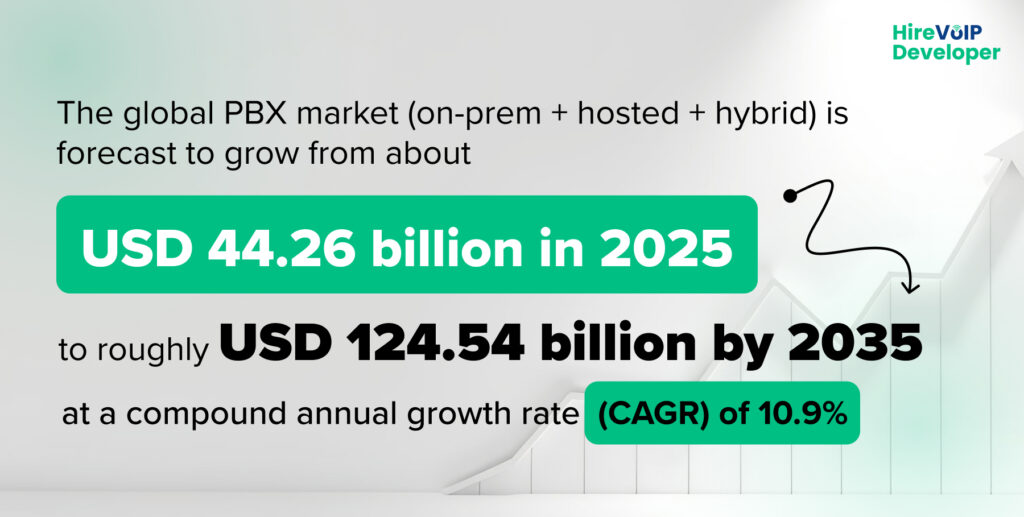
Most organizations today fall into three clear camps. Some hold onto legacy PBX setups because they’ve been “good enough.”(here’s a migration checklist for when “good enough” stops working) Others went cloud-first for quick wins and easier scaling. And then there’s the fast-growing middle group using hybrid PBX models to keep control, meet compliance needs, and still give their teams flexibility.
By 2026, PBX workloads have fundamentally changed. Mobility across devices, ultra-low latency decisioning, and edge-based workflows are no longer normal, which is why AI PBX solutions are reshaping how customer experience is delivered.
This is where traditional architectures start to fall short. They weren’t designed for distributed teams, unpredictable traffic patterns, or workloads that shift between on-prem, cloud, and edge environments. The rigidity becomes a bottleneck, affecting uptime and call quality, and can even introduce security risks if basic PBX security best practices aren’t followed.
These pressures are exactly what’s pushing PBX toward hybrid models and 5G integration, because the older framework simply can’t stretch far enough to support modern communication demands.
Why Hybrid PBX is Becoming the Default Model?
A lot of people still think “hybrid PBX” means running half your system on-prem and the other half in the cloud. That’s not how modern hybrids work anymore. Today, it’s about placing each workload where it performs best: latency-sensitive traffic close to the business, scalable workflows in the cloud, and everything else routed intelligently instead of rigidly.
What’s driving this shift?
Businesses are choosing hybrid for reasons that are less about trend and more about practicality:
- Compliance needs — Some data simply can’t leave the building, especially in environments governed by regulations like HIPAA, and hybrid gives teams a way to enforce that without slowing everything else down.
- Cost control — You don’t need to carry the heavy on-prem hardware burden for every workload, and you don’t need to pay cloud fees for tasks that don’t benefit from being in the cloud.
- Operational resilience — If one environment hiccups, the other can keep calls and workflows moving. No single point of failure is holding the entire communication stack hostage. On the signaling layer, SIP load balancing with Kamailio ensures traffic is distributed across nodes with automatic failover — so a server going down doesn’t mean dropped calls.
Where hybrid PBX wins in the real world?
You see the benefits most clearly in everyday scenarios:
- Remote and distributed teams need consistent quality, no matter where they connect from.
- Multi-site businesses that don’t want separate PBX systems, or separate headaches, for every branch.
- Regulated industries (finance, healthcare, government) where certain voice data must stay on-prem, but the rest of the operation needs cloud-level agility.
Hybrid isn’t the middle-ground option anymore. The future of PBX systems is the model that actually matches how modern teams operate. And that’s exactly why it’s quickly becoming the default PBX framework moving into 2026 and beyond.
How 5G Is Transforming PBX Systems in 2026?
5G isn’t just “faster internet.” It shifts the ground PBX stands on. Once you strip away the hype, you’re left with a network layer that finally solves problems PBX has been wrestling with for years, jitter and latency, mobility, congestion, and unpredictable call quality.
What 5G actually brings to the table?
A few things change the moment PBX rides on 5G instead of older network backbones:
- Ultra-low latency – Voice feels immediate, not “buffered with optimism.”
- Higher throughput – Heavy call loads stop choking the network during peak hours.
- Consistent mobility – Teams can move between locations without voice quality falling apart.
- Network slicing – A dedicated slice for voice traffic means no fighting with every other app.
Each of these sounds technical on paper, but they translate into one thing businesses actually care about: PBX feels smoother than it ever has.
Why this matters for real operations?
You’ll notice the difference most in places where current PBX setups struggle:
- Field teams or mobile staff who need uninterrupted calls on the move
- Branches and warehouses with inconsistent wired connectivity
- Edge workflows that demand instant response times
- Voice-heavy operations where even a small delay becomes a customer problem
Traditional PBX wasn’t built for this level of mobility or real-time performance. 5G is what finally closes that gap.
The bottom line?
A hybrid PBX gives organizations flexibility.
And, 5G gives it power.
Put those two together, and you’re looking at a communication system that behaves more like a living network than a fixed piece of infrastructure, fast, adaptable, and built for how teams actually operate in 2025-2026 and beyond.
What are the key cost factors in maintaining a hybrid PBX infrastructure?
Hybrid PBX sounds cost-efficient on paper, but the real expense shows up in how well (or poorly) the system is planned. It’s not just “some hardware + some cloud.” You’re running two environments that need to work as one, and each side has its own price tags.
1. The core cost components you can’t ignore
Even in a well-designed hybrid setup, there are baseline expenses you need to account for:
- Hardware refresh cycles — On-prem boxes don’t magically retire themselves; you’re still replacing switches, SBC for security, and backup units every few years.
- Cloud PBX usage — Per-user pricing, storage, call recording, and premium features quietly add up.
- Licensing — SIP licenses, softphone endpoints, codec packs, analytics modules, it’s rarely one flat fee.
- Carrier fees — SIP trunks, DID numbers, and usage-based charges still apply no matter how “hybrid” you get.
These are the predictable costs, but they’re not the whole picture.
2. The extra layer: 5G integration costs
Once 5G enters the architecture, you’re adding a new set of line items:
- Gateways for routing voice traffic into 5G networks
- Edge nodes if you need ultra-low latency processing near user locations
- Security layers to protect traffic moving between on-prem, cloud, and 5G slices
5G doesn’t inflate your budget for fun; it adds capabilities. But you need to factor those capabilities into the total cost of ownership.
3. The hidden operational costs
These are the parts organizations underestimate, and they’re usually where budgets go sideways:
- Redundancy — Hybrid systems need failover paths across both cloud and on-prem.
- Monitoring tools — You need visibility across networks, SIP flows, Quality of Service metrics, and edge performance.
- Traffic optimization — Routing, bandwidth shaping, and load balancing become ongoing tasks, not a one-time setup.
This is the “maintenance” cost that vendors tend to gloss over.
4. Evaluating ROI without vendor-friendly optimism
The cleanest way to evaluate ROI is to ignore feature lists and measure:
- How much downtime you prevent
- How many calls you handle without quality issues
- How much it costs to scale during peak demand
- How much you save by not over-provisioning hardware or cloud licenses
If you only compare upfront prices, hybrid always looks expensive.
If you look at operational stability, compliance, and long-term scalability, the ROI makes a lot more sense.
How can automation or AI help in managing complex PBX networks?
Hybrid PBX setups move fast, traffic shifts, routes change, devices jump between networks, and that raises a simple question: who’s keeping up with all of it without drowning in manual work?
That’s where automation and AI step in.
AI helps with the basics first: setting up users, assigning endpoints, cleaning up routing rules, and adjusting call paths when the network gets busy. It reacts more quickly than manual changes, keeping things stable during peak moments.
It also spots trouble early. Hardware and network issues always leave small clues, jitter creeping up, trunks throwing odd errors, and calls dropping in patterns. AI can catch those signals and flag them before they turn into outages.
And because hybrid environments push traffic across on-prem, cloud, and sometimes 5G, AI helps smooth out Quality of Service by quietly adjusting things like routing choices or bandwidth when the network tightens.
Just one thing to keep in mind: AI is helpful, not magical. It can optimize a good PBX setup, but it won’t fix a poorly designed one.
Wrapping Up
Hybrid PBX and 5G aren’t just upgrades but the direction PBX is moving, whether businesses plan for it or not. The systems that used to feel rigid are becoming more flexible, more mobile, and better able to keep up with how teams actually work today. And the organizations that adapt early will feel the benefits long before everyone else catches up.
If you’re looking to modernize your PBX roadmap or build a hybrid model that actually holds up in real-world conditions, Hire VoIP Developer can help you map that transition with clarity and the right technical foundation. Ready to explore what your next-gen PBX should look like? Talk to our team.