

📝 Blog Summary
A Session Border Controller does far more than route SIP traffic. It sits at the center of security, interoperability, NAT traversal, media handling, and call quality across VoIP networks.
This blog breaks down SBC architecture layer by layer, from signaling and media planes to topology hiding, media anchoring, and B2BUA processing.
Read on to understand how modern SBCs process SIP, SDP, and RTP traffic, and when building with open-source platforms like Kamailio or OpenSIPS makes sense over commercial solutions.
Open any “how VoIP works” diagram.
And, you’ll see endpoints, SIP trunks, media servers, and PBXs.
What you rarely see explained properly is the Session Border Controller(SBC). Yet in production VoIP networks, the SBC often does more heavy lifting than any other component.
Beyond security, an SBC manages signaling, controls media, enforces policies, and enables interoperability between networks. Its architecture plays a direct role in scalability, reliability, and call quality.
Whether you’re designing carrier infrastructure, enterprise communications, CPaaS platforms, or even hiring an SBC developer, understanding SBC architecture is essential for building resilient VoIP systems.
What is SBC (Session Border Controller)?
A SBC (Session Border Controller) is a network element that manages, secures, and controls SIP signaling and RTP media traffic between different VoIP networks. It sits at the network edge, protecting infrastructure, enabling interoperability, handling NAT traversal, enforcing call policies, and maintaining voice quality across communication sessions.
In simple terms, an SBC acts as the control point between communication networks, ensuring that voice and multimedia sessions remain secure, reliable, and compatible.
Components and Functional Layers of SBC Architecture:
A modern session border controller architecture consists of multiple functional layers that work together to manage signaling, media, security, and traffic control.
These layers also form the foundation of an SBC for VoIP security, helping protect networks while ensuring reliable and seamless communication across VoIP environments.
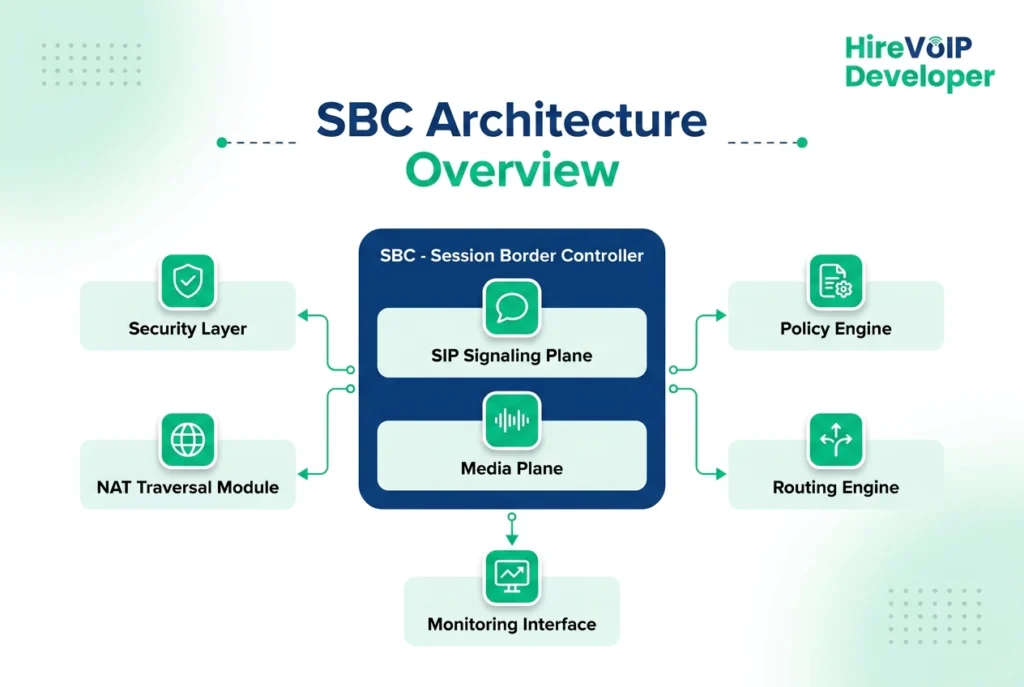
- Control Layer – Handles SIP signaling, call setup, authentication, and session management.
- Media Processing Layer – Processes RTP traffic, media anchoring, encryption, and voice quality functions.
- Security Layer – Protects the network through topology hiding, access control, and threat mitigation.
- Routing and Policy Layer – Applies routing decisions, number translation, and call handling policies.
- Management and Monitoring Layer – Provides visibility into performance, traffic, sessions, and system health.
Together, these layers enable an SBC to deliver secure, scalable, and reliable communications.
A call touches nearly every layer. Here’s how that journey unfolds.
Session Border Controller Architecture Explained
An SBC does not process all traffic in a single workflow. Signaling and media follow separate paths, while policy, security, routing, and NAT functions interact with both. This separation is a core principle of modern SBC architecture and forms the foundation of a scalable custom VoIP SBC deployment.
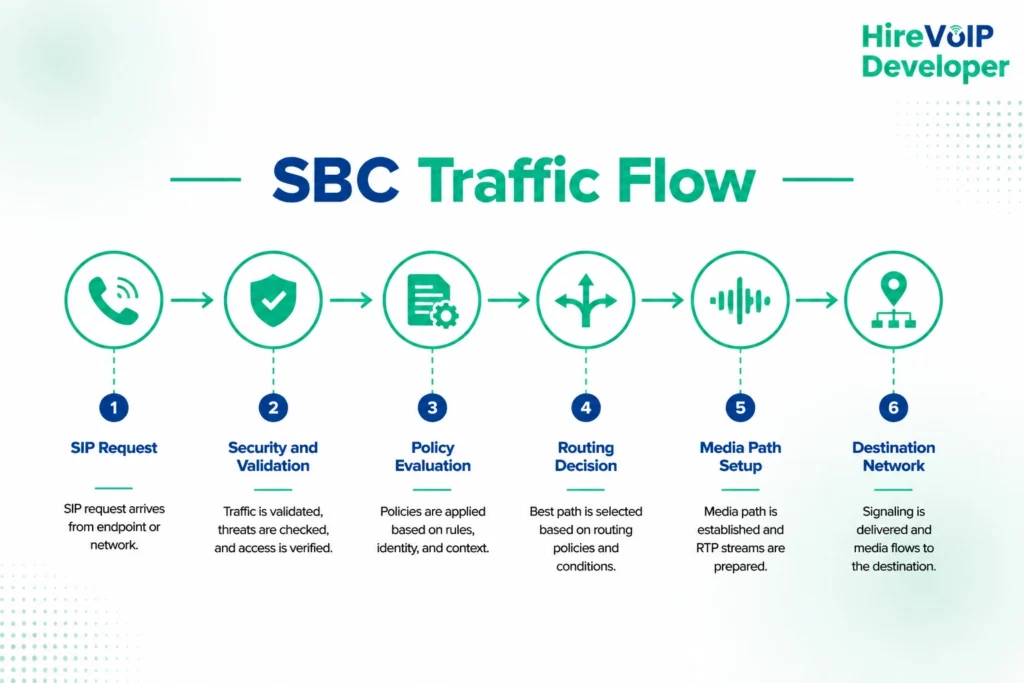
1. Inbound Session Processing
The process begins when a SIP request reaches the SBC from an endpoint, carrier, or external network. The control layer validates the request and establishes the initial session context.
2. Policy Evaluation
Once the session is identified, the SBC consults the policy engine. This stage applies authentication rules, access controls, routing policies, and interoperability requirements before the call is allowed to proceed.
3. Media Path Establishment
After signaling validation, the SBC creates the media path. SDP information is inspected, media endpoints are negotiated, and RTP streams are prepared for anchoring or relay if required.
4. Outbound Session Delivery
The SBC then forwards the processed signaling request toward the destination network. At the same time, the media plane remains ready to handle RTP traffic throughout the session lifecycle.
5. Packet Journey Through an SBC
The flow can be simplified into six stages:
6. Control Path vs Media Path
One of the most important concepts in session border controller architecture is the separation of signaling and media traffic.
- The control path processes SIP messages, authentication requests, routing decisions, and session policies.
- The media path handles RTP streams, media anchoring, encryption, and voice quality functions.
This separation allows the SBC to scale signaling and media workloads independently while maintaining consistent call performance and simplifying future SBC upgrades.
A single VoIP call may appear simple from the user’s perspective, but inside the SBC, signaling, media, security, routing, and policy engines are continuously working together to manage the session.
The flow only works because signaling and media follow different paths.
How do the Signaling Plane and Media Plane Work Inside an SBC, and Why are They Separated?
Everything inside the SBC revolves around two specialized traffic planes.
The signaling plane manages session setup and control, while the media plane handles the actual voice and video streams between endpoints.
This separation also highlights a key difference in the SBC server vs SIP server discussion, helping SBCs deliver greater scalability, security, and media control in carrier and enterprise networks.
1. Signaling Plane Architecture
The signaling plane is responsible for processing SIP messages and maintaining session control throughout the call lifecycle.
- SIP Message Processing
Every SIP request and response passes through the signaling plane. It processes INVITEs, REGISTER requests, BYEs, and other signaling messages required to establish and manage sessions.
- Registration Handling
The signaling plane validates registrations, authenticates endpoints, and tracks active user sessions across the network.
- Call Routing Decisions
Before a session is connected, the signaling plane evaluates routing rules and determines the best destination based on policies, dial plans, or carrier preferences.
- Header Manipulation
SIP headers are often modified to support interoperability, privacy requirements, and topology hiding functions within the SBC.
- Protocol Normalization
Different vendors may implement SIP differently. Protocol normalization ensures signaling remains compatible across carriers, PBXs, soft switches, and communication platforms.
2. Media Plane Architecture
Once signaling establishes a session, the media plane takes over responsibility for media traffic.
- RTP Packet Processing
The media plane processes RTP streams flowing between communicating endpoints and maintains media continuity throughout the session.
- Codec Handling
It manages codec negotiation outcomes and supports transcoding when endpoints require different media formats.
- DTMF Processing
DTMF events are detected and relayed correctly to support IVRs, conferencing systems, and other voice applications.
- SRTP Encryption
The media plane encrypts and decrypts media streams using SRTP to protect conversations from interception.
- Media Statistics Collection
Throughout the call, the SBC collects performance metrics such as packet loss, jitter, latency, and overall media quality.
3. Why SBCs Separate Signaling and Media Processing
Separating signaling and media is not simply an architectural preference. It directly impacts performance, scalability, and operational efficiency.
- Performance Benefits
Signaling workloads and media workloads have very different processing requirements. Keeping them separate prevents one from affecting the other during periods of heavy traffic.
- Scalability Advantages
Organizations can scale signaling capacity and media capacity independently. This becomes particularly important in carrier deployments and SBC development for multi-tenant environments, where traffic patterns vary across customers and services.
- Security Isolation
Separating the control path from the media path reduces the attack surface and allows security policies to be enforced more effectively across different traffic types.
- Operational Flexibility
Independent signaling and media resources provide greater deployment flexibility. Teams can optimize infrastructure, troubleshoot issues faster, and adapt architectures as traffic demands grow.
In short, the separation of signaling and media is what allows modern SBC architecture to deliver secure, scalable, and high-performance communications at scale.
This control also enables one of the SBC’s core security capabilities: topology hiding.
How Topology Hiding Works in SBC Architecture?
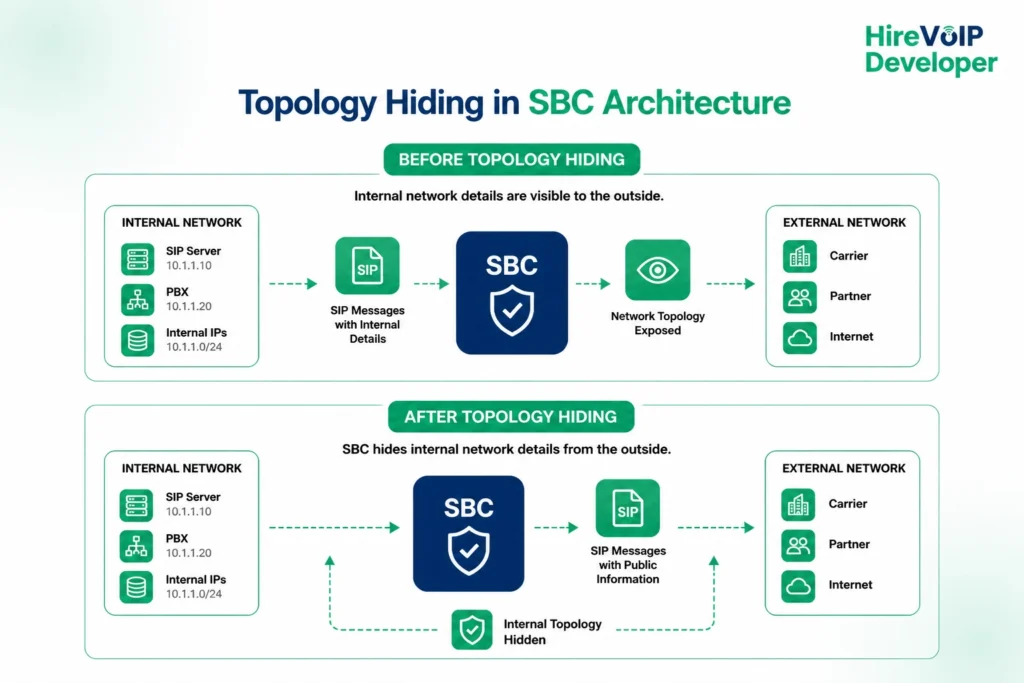
Every SIP message contains information about the network that generated it. Without protection, those messages can expose internal IP addresses, server names, routing details, and other infrastructure data. Topology hiding prevents that information from being visible to external networks.
1. Why Topology Hiding Matters
VoIP networks often connect to carriers, partners, customers, and public networks. Exposing internal infrastructure makes it easier for attackers to map the environment and identify potential targets.
Topology hiding reduces visibility by ensuring only the SBC remains exposed at the network edge.
2. How Topology Hiding Works
As SIP messages pass through the SBC, sensitive information is removed, rewritten, or replaced before the messages are forwarded.
This process can include:
- Hiding internal IP addresses
- Rewriting SIP headers
- Masking server identities
- Removing routing information
- Obscuring network structure
To external systems, the SBC appears as the only visible communication endpoint.
3. Topology Hiding in a B2BUA Architecture
Most SBCs implement topology hiding through a Back-to-Back User Agent (B2BUA) architecture.
Instead of simply forwarding SIP messages, the SBC terminates the incoming session and creates a new session toward the destination.
This creates two independent call legs:
Endpoint A
↓
SBC
↑
Endpoint B
Because the SBC sits between both sides, neither endpoint can directly view the signaling details of the other network.
4. Benefits of Topology Hiding
- Stronger Security – Attackers gain less information about internal infrastructure and network design.
- Better Infrastructure Protection – Core SIP servers, softswitches, and application platforms remain hidden behind the SBC.
- Simplified Interoperability – Network information can be normalized without exposing internal architecture details.
- Improved Regulatory Compliance – Many service providers use topology hiding to support security and privacy requirements across communication networks.
In modern session border controller architecture, topology hiding is more than a security feature. It acts as a protective layer that allows organizations to connect networks without exposing the systems operating behind them.
The most secure VoIP infrastructure is often the one outsiders cannot see, and topology hiding is what makes that possible.
Hiding the network is only half the challenge. Reaching it is the other.
How Does an SBC Handle NAT Traversal and Media Anchoring?
VoIP traffic frequently crosses firewalls, routers, and private networks that use Network Address Translation (NAT). While NAT conserves IP addresses, it creates challenges for SIP signaling and RTP media streams.
1. NAT Challenges in VoIP
SIP messages often contain private IP addresses that are unreachable from external networks. RTP streams can also fail to establish correctly, resulting in one-way audio, missing media, or dropped calls.
These issues become more common as organizations connect remote users, cloud services, and geographically distributed communication systems.
2. SIP and SDP Rewriting
A Session Border Controller solves these challenges by inspecting and modifying SIP and SDP information as traffic passes through the network edge.
The SBC rewrites addressing details, updates media endpoints, and ensures signaling remains valid between both sides of the session.
3. Far-End NAT Traversal
Many endpoints sit behind NAT devices that the service provider cannot directly control. SBCs detect these conditions and maintain session connectivity using NAT-aware processing techniques and keepalive mechanisms.
4. Media Anchoring
Media anchoring allows the SBC to remain in the RTP path throughout the call.
Instead of sending media directly between endpoints, RTP streams pass through the SBC, enabling security enforcement, NAT traversal, quality monitoring, and policy control.
As communication environments become more distributed, NAT traversal and media anchoring remain fundamental capabilities of modern SBC architecture.
How is SBC Architecture Deployed for High Availability and Scale?
A well-designed SBC architecture must remain available even when traffic spikes, hardware fails, or network outages occur.
1. Active-Active Deployments
In an active-active deployment, multiple SBC instances process traffic simultaneously. Sessions are distributed across nodes, improving resource utilization and eliminating single points of failure.
2. Active-Standby Deployments
Active-standby architectures maintain a secondary SBC that remains ready to take over if the primary system becomes unavailable.
This model is commonly used in enterprise environments that prioritize operational simplicity.
3. Geographic Redundancy
Carrier-grade networks often deploy SBCs across multiple data centers or cloud regions.
If an outage affects one location, traffic can automatically shift to another site without disrupting services.
4. Load Balancing and Horizontal Scaling
As session volumes grow, additional SBC instances can be added to distribute traffic across the environment.
This approach enables organizations to scale capacity without redesigning the entire communications infrastructure.
5. Hardware vs VNF vs CNF Deployments
Modern session border controller architecture can be deployed in several ways:
- Hardware SBCs provide dedicated performance for high-volume environments.
- Virtual SBCs (VNFs) run on virtualized infrastructure and offer deployment flexibility.
- Cloud-Native SBCs (CNFs) use containers and orchestration platforms such as Kubernetes for elastic scaling.
The right deployment model depends on performance requirements, operational goals, and infrastructure strategy.
Open-Source SBC vs a Commercial SBC
For many engineering teams, the discussion eventually shifts from SBC architecture to whether configuring Kamailio or OpenSIPS for SBC is a better path than buying a commercial solution.
1. Kamailio with RTPengine
Kamailio combined with RTPengine, provides a highly scalable open-source SBC foundation. It offers flexibility and fine-grained control for organizations with in-house SIP expertise.
2. OpenSIPS with RTPengine
OpenSIPS delivers similar capabilities, including powerful routing, topology hiding, NAT traversal, and traffic management.
Many service providers use OpenSIPS-based architectures for large-scale SIP environments.
3. FreeSWITCH in SBC Mode
FreeSWITCH can also function as an SBC while providing media processing capabilities such as transcoding, conferencing, and IVR integration.
This approach is often used when media services and session control need to operate together.
4. Build vs Buy Considerations
Open-source platforms provide flexibility and lower licensing costs, but they require internal expertise for deployment, maintenance, and long-term support.
Commercial SBC solutions typically offer integrated management tools, vendor support, compliance features, and simplified operations.
Organizations evaluating SBC development for multi-tenant environments often weigh these tradeoffs carefully, particularly when balancing customization requirements against operational complexity.
The best choice depends on technical requirements, team capabilities, and long-term business objectives.
What Are the Best Practices for SBC Architecture Design?
A strong SBC deployment is not defined by features alone. It is defined by an architecture that supports growth, resiliency, operational stability, and minimizes common SBC integration roadblocks.
1. Separate Signaling and Media Resources
Independent signaling and media processing improve performance and simplify scaling strategies.
2. Design for Redundancy
Eliminating single points of failure helps maintain service continuity during outages or maintenance events.
3. Secure the Network Edge
Topology hiding, access controls, encryption, and policy enforcement should be implemented as foundational design elements.
4. Monitor Media Quality
Continuous visibility into jitter, latency, packet loss, and session performance helps maintain communication quality.
5. Plan for Growth
Architecture decisions made during initial deployment should support future scaling requirements across users, regions, and services.
Following these principles helps organizations build SBC environments that remain reliable as traffic volumes and infrastructure complexity increase.
The Bottom Line?
A Session Border Controller is more than a security gateway. Its architecture determines how signaling, media, and network control functions operate.
From topology hiding and NAT traversal to media anchoring and high availability, every layer contributes to secure and reliable VoIP communications.
Whether you’re building an enterprise platform, CPaaS solution, or carrier network, understanding SBC architecture helps you make better infrastructure decisions.
At Hire VoIP Developer, we help organizations design, deploy, and optimize carrier-grade SBC solutions that align with their scalability, interoperability, and performance goals.