

📝 Blog Summary
While evaluating VICIdial alternatives, engineering teams and call center directors face a stark choice: keep wrestling with legacy Perl scripts and MariaDB table locks on self-hosted boxes, or pay steep monthly per-seat fees to commercial cloud vendors that throttle dialing aggressiveness.
This blog will help you compare the leading open-source and SaaS dialers, expose the hidden talk-time penalties of hosted platforms, and show how high-scale teams build their own custom predictive dialer engines using Kamailio and FreeSWITCH.
When looking for VICIdial alternatives, outbound call center leaders face a fundamental choice: keep managing their own open-source telephony servers, migrate to a fully hosted cloud platform with monthly per-seat licensing, or build a modern, high-concurrency custom dialer on their own media core.
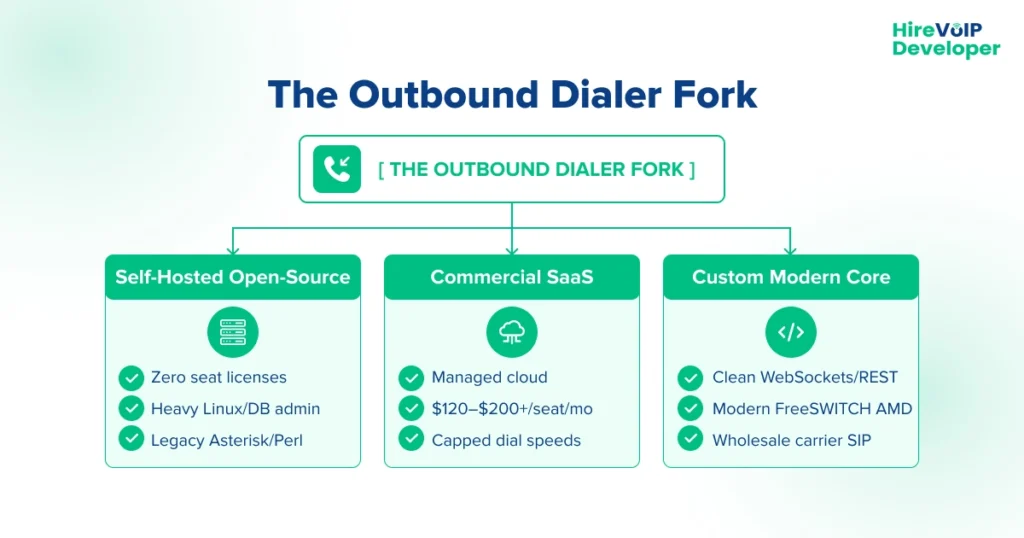
VICIdial earned its status as an industry workhorse for a simple reason: it gave floor managers total control over their dialing math with zero software license fees. When configured properly, setting an aggressive auto_dial_level of 3.5 regularly delivers 45 to 55 minutes of agent talk time per hour.
Running that stack today comes with painful technical debt:
- The user interface relies on nested HTML tables designed in 2003.
- Heavy MariaDB table locks on vicidial_auto_calls freeze campaigns during high concurrency.
- Legacy Asterisk Answering Machine Detection (AMD) routines (calibrated nearly two decades ago) frequently misclassify 15% to 20% of live human greetings as voicemail, dropping real prospects before an agent can speak.
If your floor needs a modern VICIdial alternative, here is how the top self-hosted and commercial options compare, along with the custom engineering path that high-scale operations use to escape per-seat pricing.
Open-Source & Self-Hosted VICIdial Alternatives
Open-source platforms remain the primary choice for teams that refuse to pay recurring monthly seat fees and insist on owning their server infrastructure, database schemas, and dialing algorithms.
If you want to keep your dialing stack entirely on-premises or in your private VPC, these are the primary open-source alternatives to VICIdial:
1. GoAutoDial
GoAutoDial is an open-source web application suite built on the exact same underlying VICIdial and Asterisk core, wrapped inside a responsive Bootstrap web UI.
Pros:
Far easier agent onboarding, cleaner dashboard analytics, and an integrated WebRTC webphone that eliminates the need for separate desktop softphones.
Cons:
It shares the same underlying database schema and background Perl cron scripts (/usr/share/astguiclient/) as VICIdial. The moment concurrency scales past 100 agents, you face identical database lockups and carrier optimization hurdles.
2. ICTContact
ICTContact is an enterprise-grade, open-source multi-tenant contact center platform engineered for predictive, progressive, and broadcast dialing across voice, SMS, and fax.
Pros:
Built natively on FreeSWITCH instead of Asterisk, providing lower memory overhead per channel, built-in WebRTC, a modern REST API, and flexible blended inbound/outbound queues.
Cons:
A smaller community and fewer pre-built third-party CRM plugins than VICIdial. Finding contract engineers with deep FreeSWITCH and ICTContact experience requires more effort than finding Asterisk admins.
3. FreePBX / Asterisk Standalone
FreePBX is an open-source PBX management platform designed primarily for corporate office extensions, IVR menus, and standard inbound call distribution.
Pros:
A massive global community, straightforward web administration, rock-solid stability for basic office extensions, and broad SIP hardware compatibility.
Cons:
It has no native predictive dialer engine. Turning it into an outbound campaign dialer requires expensive commercial add-ons or custom development for pacing algorithms, campaign workflows, and lead recycling.
Managed Cloud & Commercial SaaS VICIdial Alternatives
Many operations move away from open-source tools because maintaining Linux servers, debugging Asterisk configuration files, and managing caller ID spam reputation consumes too much engineering bandwidth.
According to market research published by Vantage Market Research, the smart predictive dialer market is projected to reach $14.64 billion by 2035, driven primarily by enterprises replacing self-hosted legacy tools with cloud-based predictive and compliance-focused software.
Here is how the leading commercial VICIdial alternatives stack up:
1. Convoso
Convoso is best for high-volume outbound sales floors running aggressive list-penetration campaigns.
Key features:
Dynamic pacing algorithms, connection-rate routing, automated multi-carrier reputation monitoring, and native two-way SMS follow-ups.
Pricing:
Custom, quote-based pricing. Deployments typically run between $130 and $200+ per seat per month once data and telephony add-ons are enabled.
2. Five9
Five9 is best for mid-to-large enterprise blended operations with strict regulatory oversight.
Key features:
Integrated TCPA compliance suites with hard 3% abandonment caps, automated DNC scrubbing, native Salesforce and ServiceNow integrations, and deep supervisor analytics.
Pricing:
Published tiers start around $119 per concurrent user per month for digital packages, climbing to $159 to $240+ per seat per month for core voice and predictive packages.
3. CallTools
CallTools is best for fast-paced outbound sales teams looking for quick onboarding without heavy enterprise software setups.
Key features:
Predictive and power dialing, automated local-presence caller ID rotation, live agent monitoring, whisper coaching, and built-in CRM workflows.
Pricing:
Base plans start around $89 to $99 per seat per month, with realistic operational setups averaging $110 to $130 per seat per month.
Quick Comparison Table of VICIdial Alternatives
The table below breaks down licensing models, target deployment sizes, and operational trade-offs across open-source systems, commercial SaaS suites, and custom-built dialing infrastructure.
The Hidden Trade-Off (Agent Talk Time vs Platform Control)
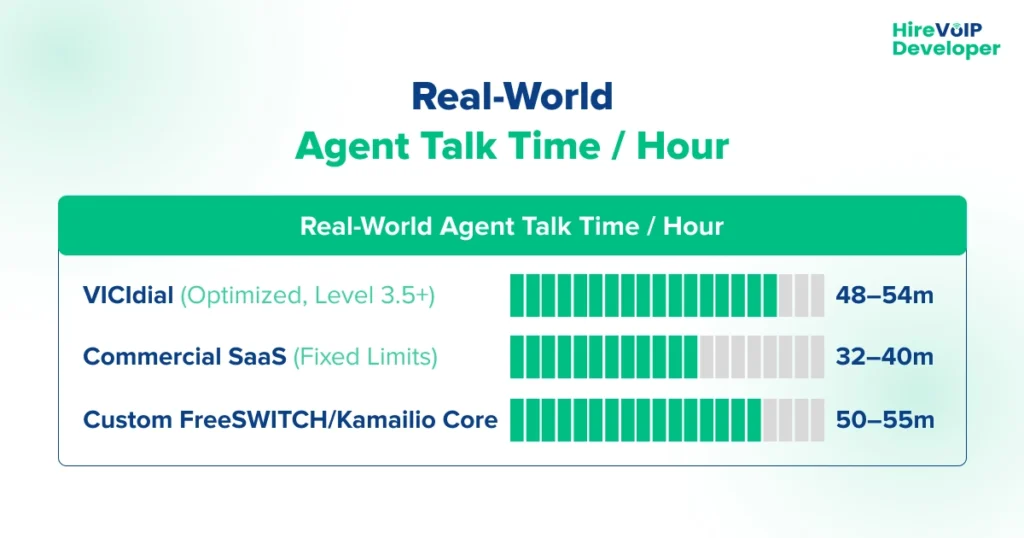
The core operational trade-off between open-source dialers and commercial SaaS platforms is agent talk time per hour versus administrative overhead. While commercial platforms remove server maintenance, their conservative dialers reduce talk time by 20% compared to self-hosted engines.
So, before jumping from an open-source dialer to a commercial cloud platform, examine this critical operational metric that sales demos rarely bring up.
VICIdial allows administrators to control the raw math of the dialing algorithm. The VD_auto_dialer cron script (running every 6 seconds in /usr/share/astguiclient/) checks agent availability against vicidial_auto_calls and calculates lines to drop on trunks based on real-time answer rates.
If you feed clean list data and set your pacing to 3.5 lines per rep, experienced teams regularly achieve 48 to 54 minutes of talk time per hour.
Commercial SaaS platforms deliberately cap dialer aggressiveness to protect their shared telecom infrastructure and enforce regulatory limits. Under the Federal Trade Commission (FTC) Telemarketing Sales Rule (TSR), abandoned calls cannot exceed 3% of answered calls across a campaign.
To avoid that risk, commercial SaaS algorithms dial conservatively. Many operations migrate from VICIdial to a modern SaaS platform only to see their agent talk time drop to 32 to 40 minutes per hour.
So, you pay around $150 per seat for a cleaner interface, yet your floor’s raw contact output drops by 20%.
How to Build a Modern Predictive Dialer (The Custom Build Path)
To build a modern predictive dialer, you need to decouple signaling from audio processing by placing Kamailio up front as a stateless SIP proxy to handle trunk traffic, while distributing active media channels across a scalable FreeSWITCH cluster running neural AMD and WebSockets.
This decoupled architecture replaces monolithic Asterisk servers with specialized microservices, letting you scale to thousands of concurrent calls without database locks or audio degradation.
If you run an outbound floor with 50, 100, or 200 agents, the build-versus-buy math becomes stark.
Paying $150 per seat for 100 agents works out to $180,000 every year in software licensing alone (before paying for a single carrier minute or phone number). Meanwhile, staying on VICIdial leaves you maintaining legacy Perl scripts and Asterisk context files.
This is why high-volume platforms choose a third path: building a custom predictive dialer that decouples media processing, call signaling, and business logic.
The Modern Telecom Core: Kamailio + FreeSWITCH
A modern outbound dialer architecture abandons the monolithic, single-server design of legacy tools. Instead, it splits tasks across specialized, decoupled layers:
1. Decoupling Signaling from Media
Rather than forcing one server to handle SIP negotiations, audio transcoding, and database lookups simultaneously, place Kamailio up front as a stateless SIP proxy.
Kamailio handles thousands of concurrent SIP handshakes effortlessly, load-balancing active media sessions across a horizontally scalable cluster of FreeSWITCH instances.
2. Low-Latency Neural Answering Machine Detection (AMD)
Instead of relying on legacy energy-based silence detection that clips the first two seconds of a greeting, modern engines stream the first 500ms of inbound audio over WebSockets to acoustic models. Human greetings get bridged to agents in under 350 milliseconds; automated answering machines and carrier error tones get dropped instantly.
3. WebRTC In-Browser Desktops
By terminating agent audio directly via WebSockets into FreeSWITCH, your agents don’t need softphones or desktop clients. Voice streams are encrypted via SRTP/DTLS and embedded directly into a modern web CRM interface.
4. Wholesale Telecom Economics
You buy wholesale SIP trunking from Tier-1 carriers at $0.003 to $0.006 per minute, eliminating third-party platform markups entirely.
💡 Expert Tip
Never run campaign dialing algorithms inside the event socket listener of your telephony engine.
If your pacing calculator executes database queries while checking lead availability, it blocks the FreeSWITCH Event Socket Library (ESL) thread, introducing audio jitter and call-transfer lag.
You need to run your predictive pacing engine inside a separate microservice using Redis for in-memory state tracking, and issue outbound originate commands over non-blocking message queues.
Which Predictive Dialer Fits Your Call Center?
The right predictive dialer depends on your seat count and technical capacity: teams with under 20 seats should choose commercial SaaS; operations needing basic inbound/outbound queues should deploy FreePBX; while floors with over 50 seats maximize margins by building a custom FreeSWITCH and Kamailio core.
Before committing budget or engineering sprints, use these three operational benchmarks to confirm your deployment model:
- How many agents sit on your floor?
If you run fewer than 20 seats, managed SaaS (CallTools or Convoso) makes sense because the operational overhead of managing servers outweighs the license savings. Once you cross 50 to 100+ seats, recurring seat licensing fees easily exceed the cost of building and owning your platform. - Do you need predictive dialing or basic inbound/outbound queues?
If your team only needs power dialing or standard inbound call queues, a simple cloud PBX like FreePBX works fine. If rapid list penetration and maximizing agent talk time per hour are your core metrics, you need an engine that gives you direct access to pacing math. - Do you prefer to self-host or pay for managed cloud?
If you have zero developers and zero telecom admins on staff, pay for commercial SaaS. If you have engineering resources or partner with a specialized telecom development firm, owning a custom FreeSWITCH and Kamailio platform delivers higher margins, full data privacy, and complete dialing control.
Finding the right VICIdial alternatives isn’t all about escaping an outdated user interface. It is mainly about building an outbound communications architecture that scales with your business, cuts your cost per contact, and ensures your agents spend their hours talking to qualified humans instead of waiting on silent lines.
If you are outgrowing VICIdial and want to engineer a dedicated, carrier-grade predictive dialer with custom FreeSWITCH and Kamailio routing, hire expert VoIP developers!