


📝 Blog Summary
This guide covered how to design, route, scale, and secure geo-distributed TURN infrastructure for WebRTC, ensuring media stays local, capacity matches peak demand, and relay traffic performs reliably at global scale.
Nobody plans to relay most of their WebRTC traffic.
It just… happens!!!!!
Symmetric NATs. Enterprise firewalls. Mobile networks.
Before you know it, TURN isn’t a backup path; it’s carrying your business.
And if your TURN servers live in one region while your users don’t, you’ve already introduced latency you can’t code your way out of.
In real time deployments, relay traffic isn’t rare, it’s normal. And once TURN starts handling a large share of your sessions, infrastructure decisions stop being background details. They become user experience.
If the media has to travel halfway across the world before reaching the other participant, you feel it. If traffic crosses regions unnecessarily, you pay for it. What works in a single geography starts cracking the moment your user base spreads.
That’s why geo-distributed TURN infrastructure isn’t optional at scale. It’s the difference between hoping your calls hold up globally and actually engineering them to.
Core Architecture of a Geo-Distributed TURN Setup
Designing this properly isn’t about simply adding more servers, it’s about optimizing TURN server infrastructure through deliberate decisions that keep media local, scalable, and predictable.
💲Hidden Cost Alert
Cross-region relay doesn’t just increase latency, it increases cloud egress charges silently.
Here’s how to approach it.
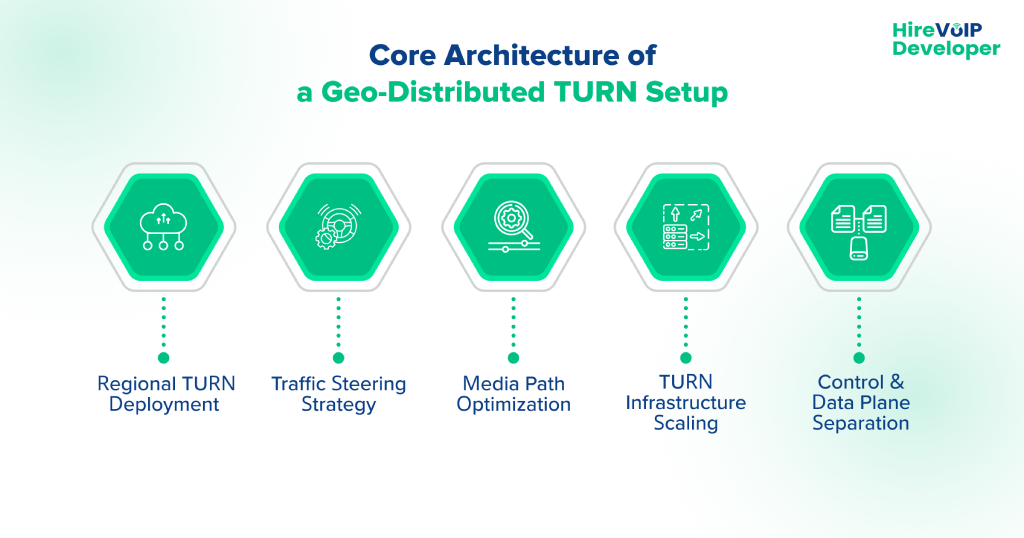
1. Regional TURN Deployment
If your users are global, your TURN deployment must be regional. A single centralized cluster guarantees unnecessary latency and cross-region media flow.
Each major geography should run its own TURN cluster so media stays local and predictable.
Key considerations:
- Deploy per-region TURN clusters (NA, EU, APAC, etc.)
- Keep nodes stateless to enable horizontal scaling
- Avoid shared state or region-crossing session dependencies
- Ensure each region can operate independently
Stateless design isn’t optional here, it’s what makes scaling and failover realistic.
2. Traffic Steering Strategy
Once clusters exist, routing becomes the real design decision.
You need a strategy that directs users to the closest healthy TURN region, not just the closest on paper.
Common approaches include:
- GeoDNS – Simple, but static and slow to react
- Latency-based routing – More accurate, requires monitoring
- Anycast IP – Single global endpoint with network-level proximity routing
- Region-specific endpoints – Explicit control via application logic
There’s no perfect model. What matters is consistency: users should allocate in-region by default, not by accident.
3. Media Path Optimization
This is where hidden latency creeps in.
If two users in the same region relay through a distant cluster, you’ve added delay and doubled bandwidth cost for no reason. Media should not leave its geography unless there’s no alternative.
To prevent this:
- Prioritize region-local TURN servers in ICE configuration
- Validate allocation geography in testing environments
- Avoid mixing global server lists without ordering logic
Media localization is the backbone of a geo-distributed TURN server WebRTC setup.
4. TURN Infrastructure Scaling
TURN server scaling WebRTC workloads is primarily about network throughput, not CPU. Instead of building large, vertically scaled instances, design for predictable per-node bandwidth and scale horizontally as demand grows.
Plan around:
- Estimated Mbps per concurrent session (audio vs HD video)
- Peak concurrent relay assumptions
- Network interface limits per node
- Autoscaling triggers tied to bandwidth saturation, not just CPU
If your scaling logic is compute-focused, you’re solving the wrong bottleneck.
5. Control and Data Plane Separation
TURN servers should relay packets. That’s it.
Authentication, routing intelligence, and policy enforcement should live outside the data plane so the relay layer stays lean and replaceable.
This means:
- Use short-lived, token-based TURN credentials
- Centralize auth logic outside TURN nodes
- Monitor relay metrics externally
- Keep the relay layer disposable
The cleaner the separation, the easier it is to evolve your infrastructure.
Geo-distributed TURN architecture isn’t about spreading servers globally, it’s about engineering where and how media flows before scale exposes your shortcuts.
❌ Myth
TURN is rarely used.
✅ Fact
In many real-world deployments, relay traffic is routine.
With the regional foundation in place, the real challenge shifts to how clients are routed and allocated to the right TURN server in real time.
How WebRTC TURN Server Routing and Allocation Works?
Most routing issues don’t show up in architecture diagrams. They surface in production complaints and sometimes in unexpected network exposure.
“Calls are fine in Europe but unstable in APAC.”
“Some users randomly hit higher latency.”
“Failover makes things worse, not better.”
In some cases, the same misconfigurations that cause uneven allocation can also expose unintended IP paths, which is why running a proper WebRTC leak test becomes critical when validating your routing strategy.
This isn’t infrastructure randomly failing. Its allocation logic is behaving in ways you didn’t explicitly design for.
Here’s what’s actually happening behind the scenes:
Stage 1: ICE Server Configuration
The TURN servers you expose to clients, and the order in which you expose them, influence where allocation happens. If regional proximity isn’t reflected in server priority, clients may relay through distant clusters even when local capacity exists. The browser follows configuration, not intent. That makes disciplined ICE ordering foundational to predictable routing.
Stage 2: Regional Allocation Logic
Once a relay candidate is selected, the chosen TURN server becomes the anchor for the session’s media flow. If routing relies solely on static DNS resolution, allocation may not reflect real-time health or congestion. That’s when users in the same geography end up relaying through different regions, creating inconsistent latency and jitter profiles.
Stage 3: Mobility and ICE Restart Handling
WebRTC sessions are sensitive to network changes. When a user switches networks or their IP changes, ICE restart may trigger a new allocation. If routing logic isn’t consistent across these events, sessions may reconnect to a different region mid-call. That’s where unpredictable quality shifts often originate, not at session start, but during mobility transitions.
Stage 4: Regional Failover Strategy
When a TURN cluster becomes degraded or unavailable, clients need a clear fallback path. Without a defined regional hierarchy, new allocations may scatter unpredictably across remaining clusters, creating congestion spikes elsewhere. Effective routing ensures that failover remains proximity-aware and controlled rather than reactive and chaotic.
In practice, routing and allocation form the enforcement layer of your geo-distributed TURN server WebRTC design. Infrastructure defines what’s possible, allocation determines what actually happens.
If that layer isn’t engineered carefully, performance differences across regions become inevitable.
⏳ Wait What?
Two users sitting in the same city can end up relaying through another continent, purely because of DNS ordering.
Once routing determines where sessions land, the next challenge is ensuring each region can sustain peak relay demand, and that’s exactly why you should give a thought to these 4 things before hiring a WebRTC developer.
How to Plan and Scale TURN Server Capacity for WebRTC
Scaling TURN infrastructure for WebRTC is less about adding servers and more about modeling reality correctly. Capacity planning must account for throughput, concurrency, transport behavior, and regional independence, all under peak conditions, not averages.
1. Traffic Volume Modeling
Capacity planning starts with peak concurrent sessions and a conservative relay ratio assumption. Even if only a portion of sessions are currently relayed, restrictive networks can shift that percentage rapidly. Once peak relay sessions are estimated, they must be translated into aggregate throughput per region.
Key inputs include:
- Peak simultaneous sessions
- Expected relay percentage
- Average bitrate per session type (audio vs video)
Because TURN relays traffic in both directions, effective bandwidth consumption doubles at the server layer. Regional throughput must be calculated accordingly.
2. Allocation and Resource Constraints
Each active relay consumes more than bandwidth. Allocations require memory, ports, and socket resources. Under high concurrency, these constraints can surface before network saturation becomes visible.
Capacity validation should consider:
- Maximum allocations per node
- Port availability limits
- Memory consumption under sustained load
Stress testing against these limits prevents unexpected degradation during traffic spikes.
3. Transport Overhead Considerations
UDP is the preferred transport, but production traffic often includes TCP and TLS relays due to enterprise firewalls and restrictive NAT environments. These transports introduce additional processing and encryption overhead.
Planning assumptions should include:
- Estimated percentage of TCP/TLS sessions
- CPU impact from encryption
- Increased retransmission behavior under TCP
Ignoring transport mix results in optimistic models that fail under enterprise usage.
4. Horizontal Scaling Strategy
TURN server scaling WebRTC environments should be driven by throughput ceilings, not just CPU metrics. Each node must operate within a defined safe bandwidth range to maintain packet stability.
Scaling signals typically include:
- Sustained network interface utilization
- Active allocation count
- Packet loss or jitter indicators
Horizontal expansion, adding more relay nodes, offers more predictable scaling behavior than vertical scaling alone.
5. Regional Capacity Isolation
In a geo-distributed TURN server WebRTC architecture, each region must sustain its own peak load independently. Relying on cross-region overflow increases latency and egress cost, weakening both performance and economics.
Regional isolation requires:
- Independent capacity buffers
- Per-region monitoring and scaling policies
- No assumption of global spillover safety
Capacity planning only works when your bandwidth assumptions are more conservative than your traffic growth projections.
But raw capacity means little if the infrastructure isn’t resilient, secure, and observable under real-world pressure.
WebRTC TURN Infrastructure High Availability, Security, and Monitoring
Even a well-designed TURN infrastructure for WebRTC can fail under real-world stress if resilience and visibility are weak. High availability, access control, and monitoring ensure that your relay layer remains stable, secure, and measurable as traffic scales.
Regional Failover Architecture – Each region must function as an isolated failure domain with controlled, proximity-aware fallback to prevent cascading outages.
Authentication and Access Control – Short-lived, token-based credentials protect TURN endpoints from unauthorized relay usage.
Abuse Prevention – Rate limits and allocation controls prevent bandwidth misuse and traffic amplification.
Operational Monitoring – Continuous tracking of allocations, relay ratios, and latency keeps performance predictable across regions.
High availability and visibility turn a scalable design into a reliable one; without them, growth exposes fragility.
Since we’ve now engineered the system end-to-end, it’s time to consolidate the principles that make geo-distributed TURN sustainable at scale.
Final Thought?
TURN is no longer a fallback; it’s the core WebRTC infrastructure. When relay traffic becomes standard, placement and scaling determine latency, stability, and cost. Without geo-distribution and worst-case relay planning, growth will expose architectural gaps.
🗝️ Key Highlights
- Keep media geographically local to protect both latency and cost.
- Scale based on sustained bandwidth, not just CPU utilization.
- Assume high relay dependency and design accordingly.
Designing a geo-distributed TURN server WebRTC environment requires expertise across networking, routing logic, and real-time media behavior.
That’s where Hire VoIP Developer comes in. Our WebRTC developers specialize in architecting resilient multi-region clusters and optimizing TURN server scaling for performance and cost – building TURN infrastructure for WebRTC that performs reliably under real-world global traffic, not just controlled test conditions.
Because once TURN starts carrying your business, it has to be engineered like it.