

📝 Blog Summary
Standard SIP proxies handle text-based signaling but crash under heavy media loads.
This guide explores how RTPengine powers high-scale VoIP and WebRTC infrastructure. We decode its in-kernel packet forwarding for low-CPU performance, ICE negotiation for advanced NAT traversal, and media forking architecture for modern voice AI pipelines.
Whether you are scaling Kamailio or OpenSIPS, this technical blueprint provides the architectural insights needed to build a resilient, low-latency telecom stack.
If you are building a modern VoIP or WebRTC platform, routing SIP signaling is only half the engineering challenge. SIP proxies like Kamailio or OpenSIPS are incredible at moving text-based signaling, but they cannot process the actual audio and video streams. If you try to force raw media through a signaling proxy, the server will crash under the load.
To handle live media, you need a dedicated relay. In 2026, the undisputed industry standard for that job is RTPengine.
Before we look at the architecture, the scale of the current media landscape is worth noting.
According to Fortune Business Insights, the global WebRTC market is projected to cross $13 billion in 2026, with cloud deployments capturing over 73% of the revenue share.
That means millions of browser-based applications are continuously trying to push live audio into legacy telecom networks. To handle that kind of packet volume without introducing latency, you need a highly optimized media proxy.
This guide strips away the dense GitHub documentation to explain exactly how RTPengine works. We will break down its architectural call flows, explain the massive performance benefits of its kernel module, and show why it is the ultimate tool for piping live audio into modern AI voice agents.
What is RTPengine, and What Does it do?
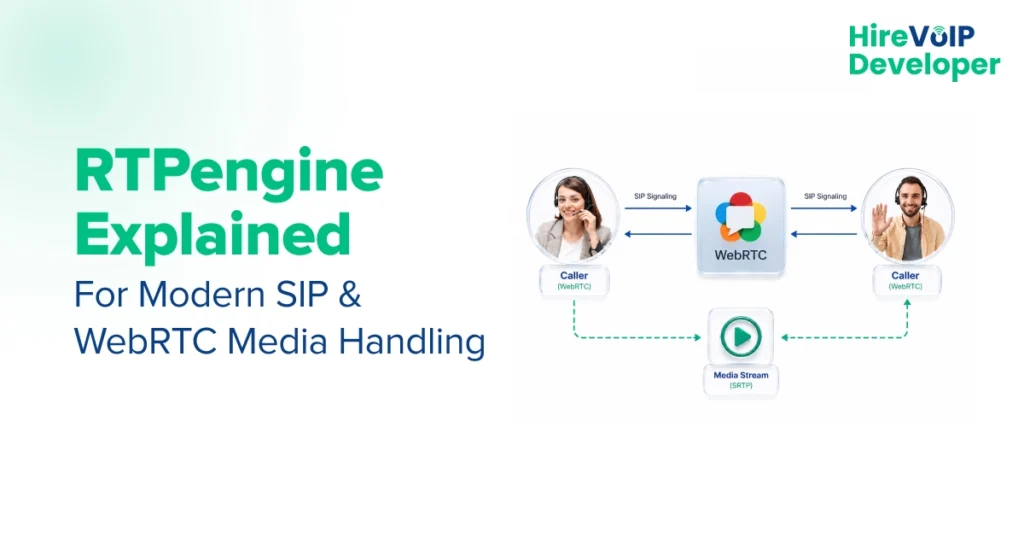
RTPengine is an open-source, high-performance media proxy that sits alongside a SIP server to route, encrypt, transcode, and manipulate real-time audio and video packets. While your SIP server manages the rules of the call (deciding who is calling whom and when to hang up), RTPengine manages the physical transfer of the conversation data.
When two endpoints try to communicate over the internet, they rarely have a clean, direct path to each other. They are usually hiding behind restrictive corporate firewalls or complex Network Address Translation (NAT) layers. If a desktop phone in a private office tries to send an audio stream directly to a mobile phone, the packets will simply drop.
RTPengine solves this by acting as a public anchor point.
Both endpoints send their media directly to RTPengine’s public IP address, and RTPengine securely bridges the two streams together. Beyond basic NAT traversal, it also acts as a translator. If a web browser sends a highly encrypted video stream, RTPengine can terminate that encryption, decode the media, and send standard, unencrypted audio down to an old legacy PBX system.
What is the Kernel Module and Why is it Important?
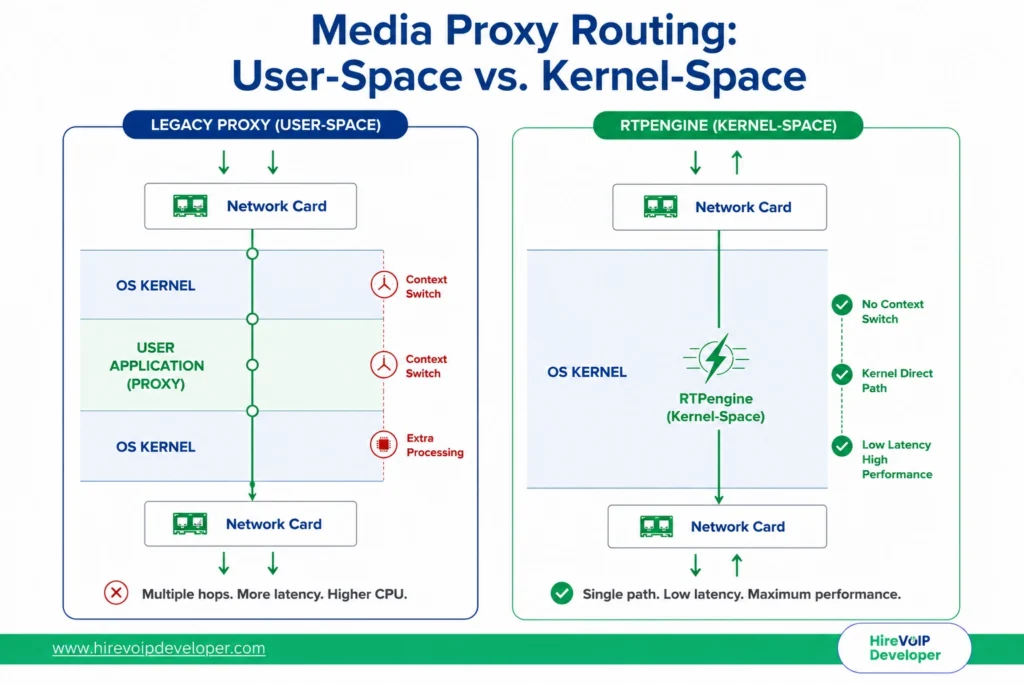
The kernel module is an architectural feature that allows RTPengine to forward media packets directly at the operating system level, bypassing the user application layer entirely to drastically reduce CPU load.
Most older media proxies operate entirely in “user space.” This means every single audio packet arriving at your server has to climb up from the network interface card, pass through the operating system’s kernel, enter the proxy software, get processed, and then travel all the way back down to be sent out. When you have 5,000 people talking at once, that round-trip creates a massive CPU bottleneck.
RTPengine completely bypasses this traffic jam using an in-kernel packet forwarding module.
It intercepts, modifies, and routes the RTP media packets directly at the operating system level. The proxy doesn’t have to pull the data up into the user application unless it’s doing heavy tasks like audio transcoding.
Because of this kernel-space processing, a single RTPengine instance can easily juggle 10,000+ concurrent active calls while your server’s CPU barely breaks a sweat at 30%.
How Does Kamailio Hand Media Over To RTPengine?
Kamailio and RTPengine operate as two separate entities. To make them work together, Kamailio uses a lightweight control protocol called ng to ask RTPengine to step in, open UDP ports, and rewrite the Session Description Protocol (SDP) of the call.
A massive gap in most documentation is the lack of a clear explanation of how the signaling and media actually separate during a live call setup.
When you get deep into SIP architecture, you have to understand this handoff. Here is the step-by-step flow of a standard SIP INVITE:
- The Inbound Request: User A sends a SIP INVITE to Kamailio. Attached to this INVITE is an SDP payload containing User A’s private IP address and their preferred audio codecs.
- The ng Protocol Handshake: Kamailio reads the INVITE and realizes the endpoints are behind different NATs. It pauses the SIP routing and sends an rtpengine_offer() command to RTPengine via the ng protocol.
- The SDP Rewrite: RTPengine opens up local UDP ports to prepare for the audio. It then physically rewrites the SDP payload, erasing User A’s IP address and inserting its own public IP address. It hands this newly modified SDP back to Kamailio.
- The Outbound Request: Kamailio forwards the INVITE (now containing RTPengine’s IP address) to User B.
- The Media Flow: When User B answers, both users send their actual audio data to RTPengine’s public IP address. Kamailio steps back from the media entirely, continuing to handle only the text-based SIP messages (like BYE or HOLD).
Does RTPengine Handle ICE Candidate Negotiation?
Yes, RTPengine handles Interactive Connectivity Establishment (ICE) candidate negotiation flawlessly. It acts as a secure bridge, allowing highly encrypted WebRTC browser sessions to communicate directly with legacy SIP desk phones without connection failures.
A web browser running WebRTC cannot talk directly to, say, a Cisco SIP desk phone. The browser mandates strict security (specifically DTLS-SRTP encryption) and uses ICE protocols to aggressively punch through NAT firewalls to find the best media path. A legacy SIP phone, however, has no idea what ICE is and expects a simple, unencrypted RTP connection.
RTPengine sits exactly in the middle of this compatibility nightmare.
When the browser sends its encrypted, ICE-negotiated audio stream, RTPengine terminates the DTLS-SRTP encryption, strips it down, and spits out standard, unencrypted RTP to your legacy PBX network. It acts as a universal, real-time translator.
Secure Your Media (Prevent RTP Bleed And Injection)
Because RTPengine acts as the public anchor for your media, it is a prime target for network attacks.
RTPengine uses “endpoint learning” to figure out exactly where to send media by looking at the source IP of the first few packets it receives. However, if configured improperly, this creates vulnerabilities like RTP Inject (where an attacker injects fake audio into an active call) and RTP Bleed (where an attacker redirects the media stream to listen in on the conversation).
To lock down an RTPengine deployment, engineers must move away from default settings. You need to enforce strict source learning, utilize the recrypt flag to fully validate encrypted SRTP sessions, and bind your control interfaces to isolated, internal VLANs.
💡 Expert Tip
When connecting Kamailio or OpenSIPS to RTPengine, never let your ng control protocol run on your public network interface. Always bind it to a dedicated, private local loopback or internal VLAN.
If you force your rapid-fire signaling control messages to compete for bandwidth on the same network interface as your heavy, public RTP media traffic, you will experience nasty micro-delays in call setups during peak volume.
How RTPengine Powers Voice AI And Media Forking
One of the reasons RTPengine is trending in 2026 is Artificial Intelligence.
If you are building a modern contact center, you likely want to drop an AI voice agent into a live call, run real-time sentiment analysis, or power a live transcription pipeline. To do that, you have to get the live audio data out of the phone call and into the AI model. You cannot just hijack the active audio stream, or your customer will hear dead air. You have to duplicate it.
RTPengine is uniquely built for media forking. Using its publish/subscribe architecture, RTPengine taps into an active conversation, duplicates the RTP stream natively in the kernel, and pipes the copy directly to a transcription model or an LLM via WebSockets.
It does this instantly, without adding a single millisecond of latency to the live human conversation. This exact underlying mechanic is what makes real-time AI voice agents possible.
What More⁉️
Trying to pipe live audio into an AI engine?
Media forking can be complex. If your AI transcriptions are inaccurate due to packet loss, or you are struggling to bridge SIP audio into a WebSocket for your LLM, we can build the exact routing logic you need.
Talk to Our Voice AI Engineers!
The 2026 Media Proxy Decision Framework
Engineers evaluating their SIP stacks often waste days trying to figure out which tool fits their specific architecture. If you are comparing your options, here is the definitive breakdown:
If you are scaling a modern telecom network, RTPengine is not optional; it is foundational.
Use it when you are building a Kamailio or OpenSIPS core, when you need to bridge modern browsers to legacy SIP trunks securely, or when you are building the advanced media-forking pipelines required for the next generation of Voice AI.
Want to stop wrestling with dropped packets and off-the-shelf software limitations, and start building media infrastructure that actually scales with your vision?